

WARNING—SPOILERS FOR “STRANGER THINGS”
Have you heard about the “Stranger Things” audience conspiracy of conformity gate?
Yeah, me too.
I think most of us have at this point.
From the 1983 vanishing of our bowl-cut hero, Will Byers, in the first season to the town being split and getting invaded by the Upside Down in the fifth and final season in 1987, the plot of “Stranger Things” has taken a turn for the worse — both for the characters and for the fans.
For starters, the 10-minute fight it took to defeat Vecna was … underwhelming, to say the least, considering how complex of a villain he was. I expected more of an adventure than just shooting at some extraterrestrial monster and impaling the final boss on a spike using the same powers Eleven had since the very beginning.
Also, many beloved characters received quite unfortunate fates, like Steve Harrington, destined to be plagued by middle schoolers as a baseball coach, and Jim Hopper, forever regretting the loss of both of his daughters. Alongside the insufficient endings for the four main boys, the common denominator is that it really was such an anticlimactic ending to a literally otherworldly show. After all of the supernatural events they have undergone, why would they be destined to live out the rest of their lives like regular people?
In an attempt to answer this question, conformity gate was born.
Fans created the theory hoping the show would release a new “secret” episode on Jan. 7 — an oddly specific date, wouldn’t you say?
Well, the series’s enthusiasts begged to differ — and they brought proof.
Unlucky Number Seven
Looking all the way back to Season 1, what number did poor Byers roll in his last game of Dungeons & Dragons before his disappearance? A seven. Coincidence? Maybe. Until you realize that a D&D dice rolled in the final scene of the show displays the same number.
While I do believe in coincidences, it does seem like a very particular full-circle moment, given that it rewinds back to the entire beginning of the series. Perhaps it was done just for that purpose — but there’s always a chance there could be something more to it.
Vecna’s Grandfather Clock
Tick-tock goes the clock as the fans anxiously wait for the fateful day to arrive.
Oh wait …
There’s no tick-tock.
This haunting sound of Vecna’s grandfather clock reverberated all throughout Season 4, but in Season 5, its chime was minimal. The idea was that the clock was counting down to Vecna’s success in taking over the real world — and that the clock stopping signified his victory. As conformity gate is backed by the idea that Vecna did emerge victorious after all, this sudden quietness makes this conspiracy more plausible.
“X-A-L-I-E” Theory
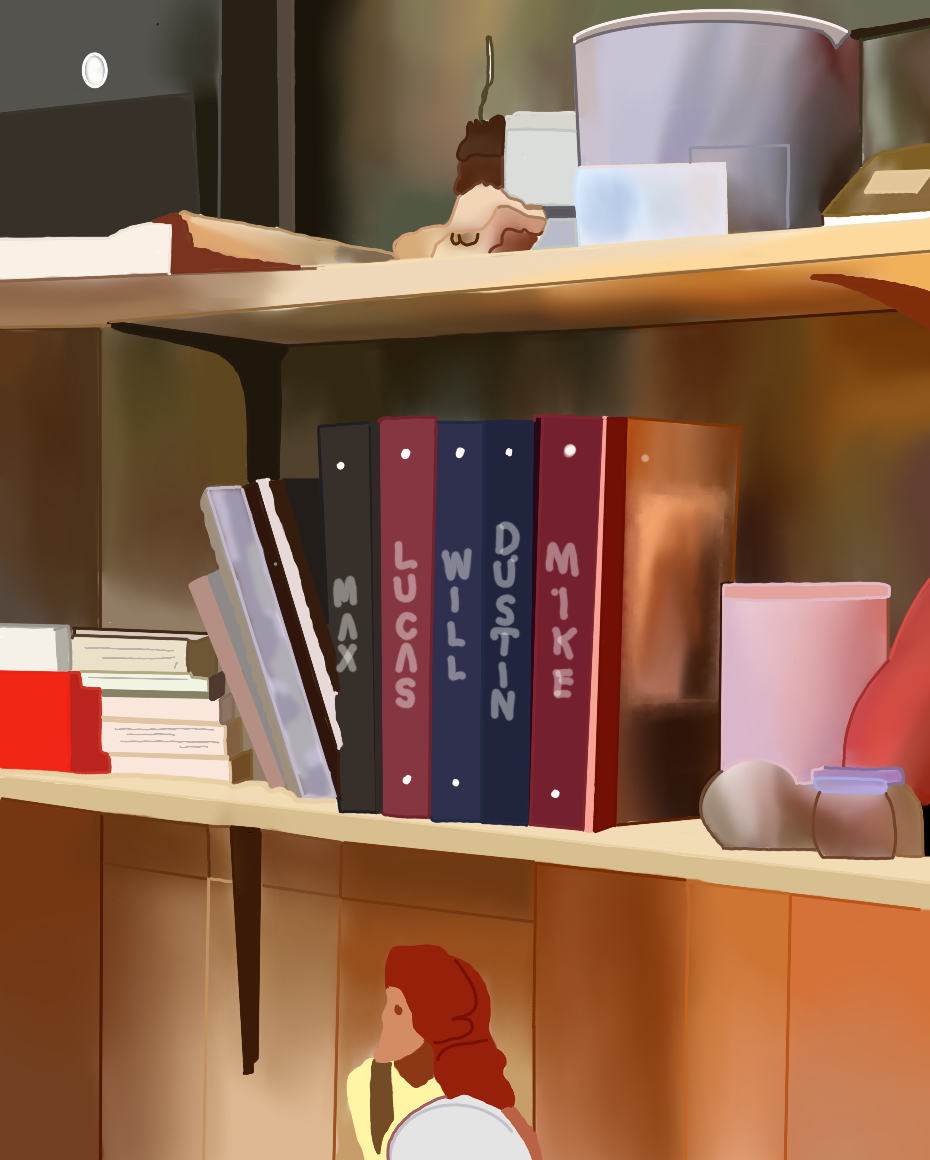
Another major piece of evidence to back up this theory is the “X-A-L-I-E” concept. Despite seeming like a collection of gibberish at first glance, fans speculated a deeper meaning. If you look at the D&D binders that Max Mayfield, Lucas Sinclair, Byers, Dustin Henderson and Mike Wheeler put up for the last time at the very end of the finale episode, you can see that the letters in their names line up to form the phrase “X-A-L-I-E” … or “X A LIE.”
“X” marks the spot, right?
Well, in this case, it does. The “X” represents Dimension X, also known as the Abyss — the spot where Vecna “died”.
“Died” as in the concept behind the “X-A-L-I-E” theory is that Vecna wasn’t actually killed, but rather, is maintaining an illusion of a normal Hawkins through his powers of mind control and fabrication. Personally, I think his death was very clear, and that the “off” atmosphere of this new Hawkins was more closely related to emotional factors, such as the crash of the “adrenaline high” after defeating the villain the characters had been chasing for so long.
When the characters all return to Hawkins after Vecna’s “defeat” and Eleven’s apparent sacrifice, the town seems quiet — too quiet. Too perfect. While I argue that this is due to the tragic mood reflecting Hopper and Wheeler’s loss of Eleven, many believe they were not in Hawkins, but rather, in an illusory version of it controlled by a still living Vecna. Though this would certainly make for an exciting spinoff, I do think that making it all be fake would overcomplicate the plot when it already had a fine ending.
But how could Vecna be alive? He was impaled by Eleven and decapitated by Joyce Byers in an ultra “protective mom” move. Perhaps this was all feigned as well — it would explain, after all, why Eleven didn’t exert herself to the same degree defeating him as she did with much simpler tasks earlier in the show, such as telekinetically picking up a truck.
Graduation
To refresh your memory, the primary color of Hawkins High School, where the main characters attend, is green. So why are they all dressed in bright orange graduation gowns?
Though the costume designers stated that this was to provide contrast against the green outdoor background, one might say that this is a cover-up for a plot hole — or that the color gives off more … prison-chic than freedom. To which I say … exactly. Going hand in hand with the idea that this returned-to Hawkins is but a mirage that Vecna created, who’s to say that they aren’t trapped in it?
In fact, there is another sign that they may be under Vecna’s control — something so subtle that it completely went over my head … the characters’ arm positions at graduation.
Arms in front of them.
Hands clasped.
Good manners? Ha, that’s what I originally thought, too.
But no … it’s submission.
It’s the same position that we consistently have seen Henry Creel/001/Mr. Whatsit, Vecna’s many human forms, take and more importantly, that we’ve seen stamped onto other victims of his.
This gesture mimics one’s hands being confined to handcuffs. Especially alongside the prison-like graduation gowns, these puzzle pieces started to really fit together in my mind.
Exit Signs
As the main exit, that of the series, came nearer, there seemed to be multiple others appearing.
At Enzo’s, where Hopper (finally) proposes to Joyce … an exit sign.
At a bar, where Will is depicted amidst his foreseen travels … an exit sign.
In the movie theater, where Sinclair and Mayfield finally get their date … an exit sign.
While I do think that these are all very normal places for exit signs to be and that they could also be symbolic of the show’s conclusion as an exit in and of itself, it is argued that the sheer number of them screened with no significant purpose highlights the idea that the characters have not yet escaped from Vecna, nor his notorious plans.
A story can’t end with the villain prevailing. A story can’t end with the heroes defeated. Though I disagree with both of these statements, generally speaking, I do think it’d be rather weird for such a long-running, hero-central show to end on a high note for the antagonist. These loose ends — the ideas that the heroes must win — are why conformity gate was created.
Because the loose ends have not been tied.
Whether this was because of plot holes (of which there are many) or because of unfollowed and seemingly nonpurposeful clues, it is easy to see why fans don’t think the show should have ended here.
I don’t think that conformity gate should have been real, as I think that it would have overcomplicated the end of the series more than it already was. To me, these hints seem so ordinary that I find it incredibly hard to believe they were actually intended to suggest an alternate ending. Rather, the creation of the theory, ultimately, seems to be derived from a combo of grief and love for the show.
Stranger Things Quiz
There was an error. Please try again.
8 Total Questions






Ava Novak • Feb 11, 2026 at 8:51 am
great story!