“I always knew I was going to be in a STEM-related major, but I didn’t know exactly which abstraction I would be pursuing.
In 9th and 10th grade, I was searching for a way to differentiate my interests. I needed to find that one thing that clicked, but I hadn’t found it yet.
Everything changed during the summer before my 10th-grade year. I was introduced to VEX robotics from a friend that went to Carnegie, and I got inspired so we decided to build a Bellaire team from the ground up. We were starting from nothing, just figuring it out as we went.
That was the spark. Since then, I’ve worked my way up the ladder of all the complexities and amazing little bits that robotics has to offer.
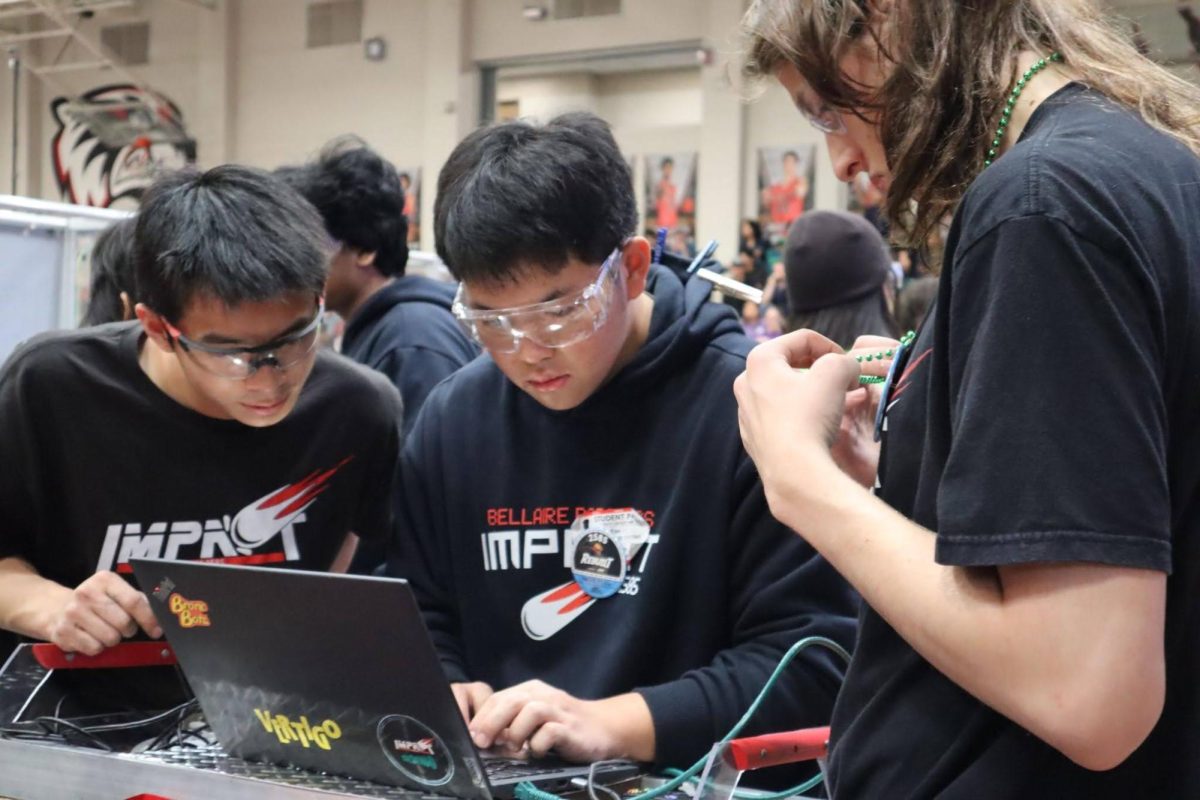
I eventually transitioned into FIRST Robotics Competition (FRC), where the stakes got higher. For the past two years, I’ve found my place on the software side. In FRC, the programmer carries a unique burden of full system understanding. You can’t just sit in a corner and type; you have to know every inch of the machine.
The control inside of the robot doesn’t stop at just writing code. It demands fluency in literally everything, starting from physical organization patterns to the tolerances imposed by metal fabrication. It’s a very different perspective than other roles. If you’re a builder, you focus on the physical assembly and if you’re in computer aided design (CAD), you focus on the design and the drive team.
As a programmer, I’m probably the only one who actually needs to have that full system view. In order to know what your code is doing to the robot, you have to know how the robot itself works. I have the opportunity to collaborate individually with every single sub-team. But I’m constantly talking to the mechanical team to understand the subsystems they’ve built.
I also have to work closely with the drive team and our game gurus. We talk about specific functionalities they want, things that only I can handle through the software. That sort of responsibility, where I’m accountable for every layer of the robot, is what I enjoy the most. It’s not just about the screen; it’s about how the code breathes life into the metal.
The work doesn’t stop when the season ends. During the off-season, between August and December, we cycle through officer roles. It’s a time for the new leadership team to familiarize itself with their responsibilities. For me, that meant writing documentation and prepping the team for new software, which allows us to know where the robot will land at all times. I had to learn the old code inside and out after our previous lead left.
Once January hits and the game is finally released, the real on-season begins. It’s a 10-week sprint where we CAD, plan, build and program. My sub-team and I try to pre-code as much as possible in those first few weeks. We want to have a solid base ready so that by the time the build team finishes the physical robot, we can hit the ground running.
The competition schedule is intense. There are seven weeks of district events before State and Worlds, and each team plays in at least two events to dictate their district placement. This year we played in weeks three and five. Those gaps are crucial because they give us the wiggle room to enhance our performance and prep our team for the big stage.
Looking back, I realize how much I’ve grown since that first room in 10th grade. But robotics remains the core. It’s taught me that software isn’t just an island; it’s the brain of a much larger, more complex body.”