

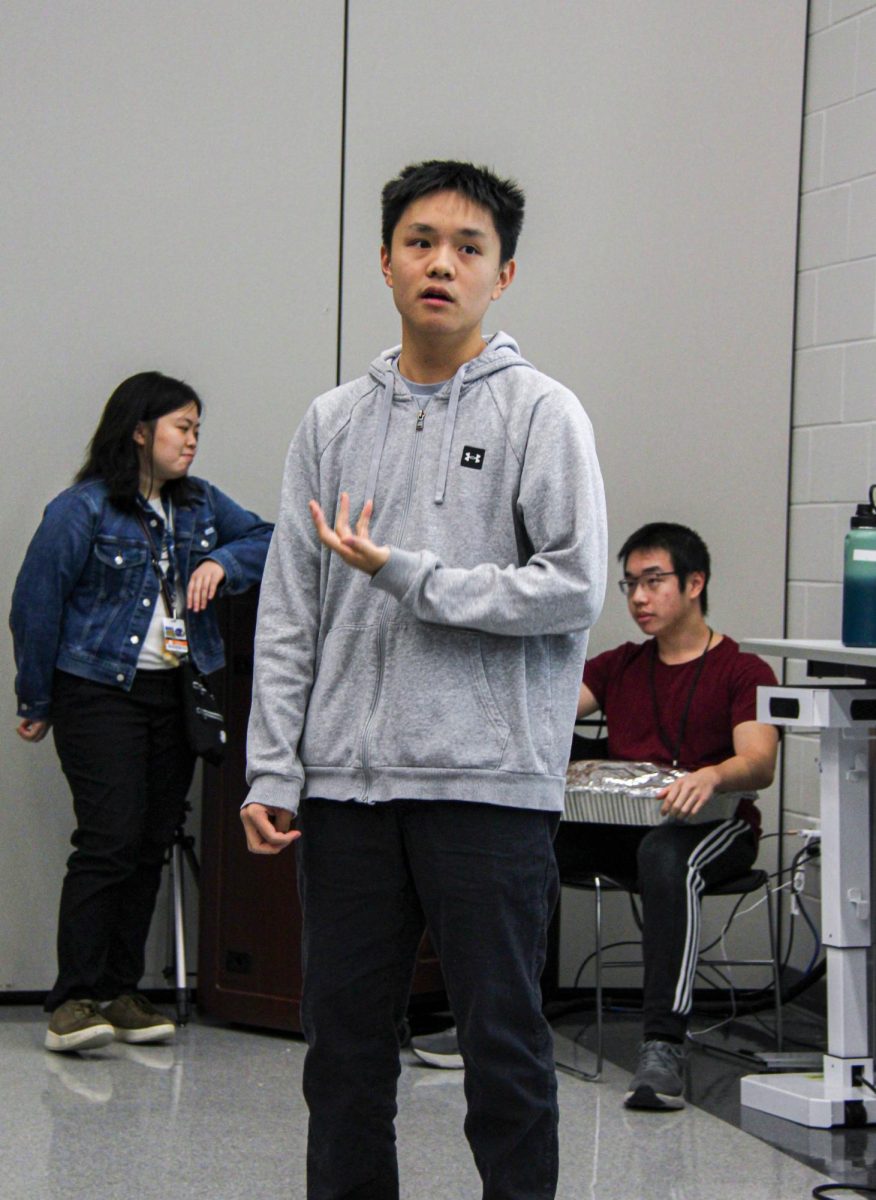
Students for Green Chemistry hosted its third guest speaker seminar during Cardinal Hour in LGI 1 on Thursday, Dec. 11 with Dr. Gremaud Ludovic, a professor at the University of Applied Sciences and Arts of Western Switzerland.
Over 150 students attended the presentation, and Ludovic focused on how mechanochemistry could transform how pharmaceuticals and fine chemicals are manufactured. In chemistry, solvent usage remains a major contributor to cradle-to-gate life cycle impacts for active pharmaceutical ingredient production. To avoid damaging the environment, researchers and scientists can reduce the use of excess chemicals and avoid solvents when possible.
According to senior and President of Design Kelly Guo, the Students for Green Chemistry invited Ludovic after learning about him through Dr. Bruce Lipshutz, who spoke for the group in early October.
“Dr. Ludovic is actually a student of Dr. Lipshutz,” Guo said. “Dr. Ludovic is really famous in Switzerland for mechanochemistry, and we wanted to introduce this concept to high schoolers, since most people probably don’t know what this is.”
Although mechanochemistry is still an emerging field, there is a growing number of publications about the topic. Ludovic’s presentation elaborated on how mechanochemistry and electrochemistry are two sectors that are still in progress, but have potential in protecting the environment.
For senior and Treasurer Aris Barut, meetings with professors like Ludovic are important to preserving the planet, and Students for Green Chemistry aims to raise awareness.
“I hope students will gain insight into more efficient chemical processes, which is what the goal of these seminars is,” Barut said. “A big cause of global warming will be these poor, inefficient chemical processes, and we have an obligation to give back to this planet.”
As someone “planning on majoring in biomedical engineering,” senior and treasurer of the Eco-Zoology Association Akshatha Perumal learned that chemistry went beyond just science and could be viewed as an engineering challenge with different ways to minimize hazardous pollution.
“It was surprising how dramatically mechanochemical equipment can reduce or even eliminate the use of solvents in chemical synthesis,” Perumal said. “It was also fascinating to see real-world examples where these methods not only cut waste, but also improve reaction times.”
After winter break, Students for Green Chemistry will host a workshop to demonstrate green chemistry principles through a click reaction conducted in a water media.
To learn more about Students for Green Chemistry and its future meetings, follow its Instagram @s4gcbhs and visit its website at tinyurl.com/students4gc.








Claire • Dec 15, 2025 at 1:40 pm
great article 😀