
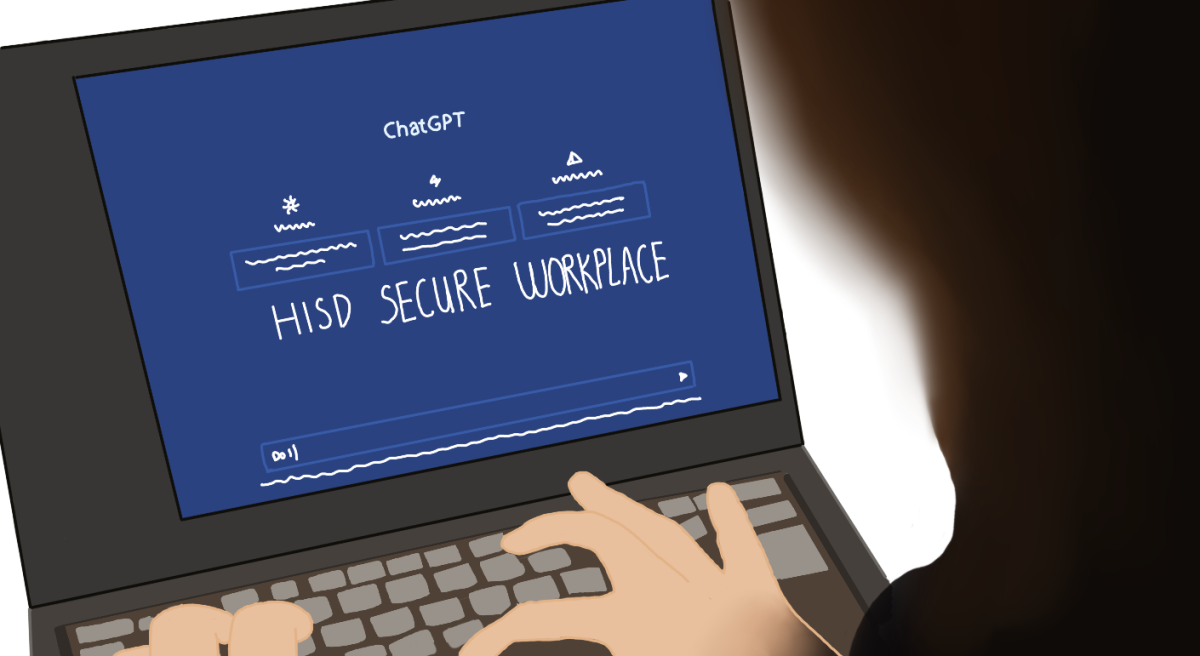
In an effort to protect student data, Houston Independent School District (HISD) has partnered with OpenAI to provide a free “HISD Secure Workspace” to teachers and HISD faculty until June 1, 2027.
The “walled garden,” as HISD Chief Technology Officer, Kerri Holt called it, is the HISD Secure Workspace, which is part of the ChatGPT Edu initiative. The HISD Secure Workspace ensures that any information imputed into ChatGPT over HISD servers is not used to train the AI model nor shared with anyone. Hence, information such as student data or grades teachers might share with ChatGPT is kept private. In contrast, typically any information inputted to ChatGPT by any user can be used for training and seen by OpenAI employees.
HISD is the largest of 15 school districts and charters nationwide to adopt this program. Holt said that when she approached OpenAI with the idea for a “walled garden” in 2024, she learned OpenAI already had ChatGPT Edu underway and was willing to provide this technology to school districts for free. Holt said HISD “aligned well with OpenAI’s interest in seeing how AI can be used responsibly in high-impact public institutions.”
“We believe HISD is proving what’s possible when a public school district doesn’t fear the future, but builds it responsibly,” Holt said. “We could have shut AI down entirely. Instead, we chose not to fear it — to learn how to use it well and to teach our students how to do the same.”
When choosing which AI company to work with for the “walled garden” initiative, Holt said HISD considered response speed, tone and quality.
“Within Information Technology at HISD, we already use AI extensively,” Holt said. “AI writes code for us, and we intentionally use multiple tools — including Copilot, Gemini, ChatGPT, and Claude — because each has different strengths. Through our own real-world use cases, we were confident the outputs we were getting were high quality, which is why we chose to partner with ChatGPT.”
Although she believes that AI can be useful in classrooms, Elizabeth Chapman, English department chair and teacher, is concerned that this technology may be seen as a shortcut and a way to standardize processes and experiences, like teacher-student communication, reducing the role of student-teacher relationships in learning.
“I think that we need to look at the heart of what we want,” Chapman said. “The learning experience is fundamentally an interaction between two human beings, the student and the teacher. When we reduce that human component by, for example, grading student work with AI, we’re taking away something that has worked in that formula and that dynamic for millennia.”
While there are potential drawbacks, according to Holt, one of the primary reasons this AI initiative was created was to reduce the workload of teachers. She said this tool is not meant to create curriculum and teach, but rather to remove the administrative overhead teachers face.
“We want teachers to have more time for students, and we want students to have a school system that works smoothly and prepares them for the future,” Holt said. “If we make the system cleaner and faster, then teachers can focus on teaching and students can focus on learning.”
However, some teachers, including Chapman, worry that this AI tool will come with the expectation of taking on more work.
“What I am worried about is that there might be an expectation that teachers are able to handle increasing workloads because of the assumption that they should be outsourcing some of this work to AI, so I’m hoping that doesn’t enter into the calculation,” Chapman said.
Chapman feels AI is a tool with the potential to be used either strategically or ineffectively.
“I feel conflicted,” Chapman said. “I think there is a lot of positive potential for the use of AI, but for any really powerful tool, it never just cuts one way. I think it could also be very destructive, and we need some guardrails, guidance and conversations about how to implement it responsibly.”
In terms of training for using the HISD Secure Workspace, Holt said she’s considering sound bites, similar to TikTok videos, to inform teachers how to use the HISD Secure Workspace. The HISD Secure Workspace is already available to anyone using ChatGPT over HISD servers.
“We’re going to give teachers training as time goes by,” Holt said. “But my first priority was creating a safe environment, so teachers who already wanted to use ChatGPT could do so responsibly, right away.”
Alaa Hourani, a Career and Technical Education (CTE) Networking Systems teacher, appreciates having her and her students’ information secure. Hourani also expects that the HISD Secure Workspace will save her time and allow her to focus on core skills, including how to teach.
“I will spend more time focusing on how to deliver the information to students and how to prepare myself, so I don’t have to spend a lot of time using the curriculum to prepare myself,” Hourani said. “I can finish any small task that needs a lot of time quickly, so I can save my time to do something else.”
According to Hourani, teachers will appreciate this initiative, because they are already using AI platforms including ChatGPT, Gemini and Microsoft Copilot daily. .
“They’re going to keep using it, but now with a platform to secure their information,” Hourani said.
For junior Aayush Khadse, learning how to use AI properly is a necessary skill for the future, for students and teachers alike. But, he also believes the use of AI should be limited to a degree.
“I think it’ll be positive for most teachers,” Khadse said. “I’ve noticed a lot of my teachers already use AI. I’m not saying that’s a bad thing. A lot of people actively use ChatGPT to explain concepts. Obviously, there’s drawbacks for every initiative. One potential drawback is the chance that teachers think this is like a replacement for what they should be doing, but it’s not. It’s a supplement.”
Khadse also believes HISD’s partnership with ChatGPT to be beneficial to OpenAI.
“OpenAI probably wants to promote their large language models across the younger generation, so they can gain more interest,” Khadse said. “They probably need a future generation of innovators, and they don’t want people to be foreign to AI.”
Like others, Chapman said she’s unsure of how AI in education will evolve in years to come.
“I think there are too many variables to predict with a lot of accuracy what is going to happen at this point,” Chapman said. “If we could go back, I never could have anticipated that it would have changed things to the extent that it has today, and so I feel very inadequate to make any kinds of guesses about what it’s going to be like three years into the future. I just know that we have kind of a wild west environment with it, and I think that it’s never a bad idea to slow down and do things more carefully, especially when kids are involved.”
For more information, visit HISD’s website regarding the HISD Secure Workspace.





Cindy Tint • Feb 10, 2026 at 3:39 pm
Super detailed and interesting Mallika!
Alia • Feb 4, 2026 at 7:50 am
Love this!!!
Alav • Feb 3, 2026 at 7:49 pm
Important and well written news story Mallika!