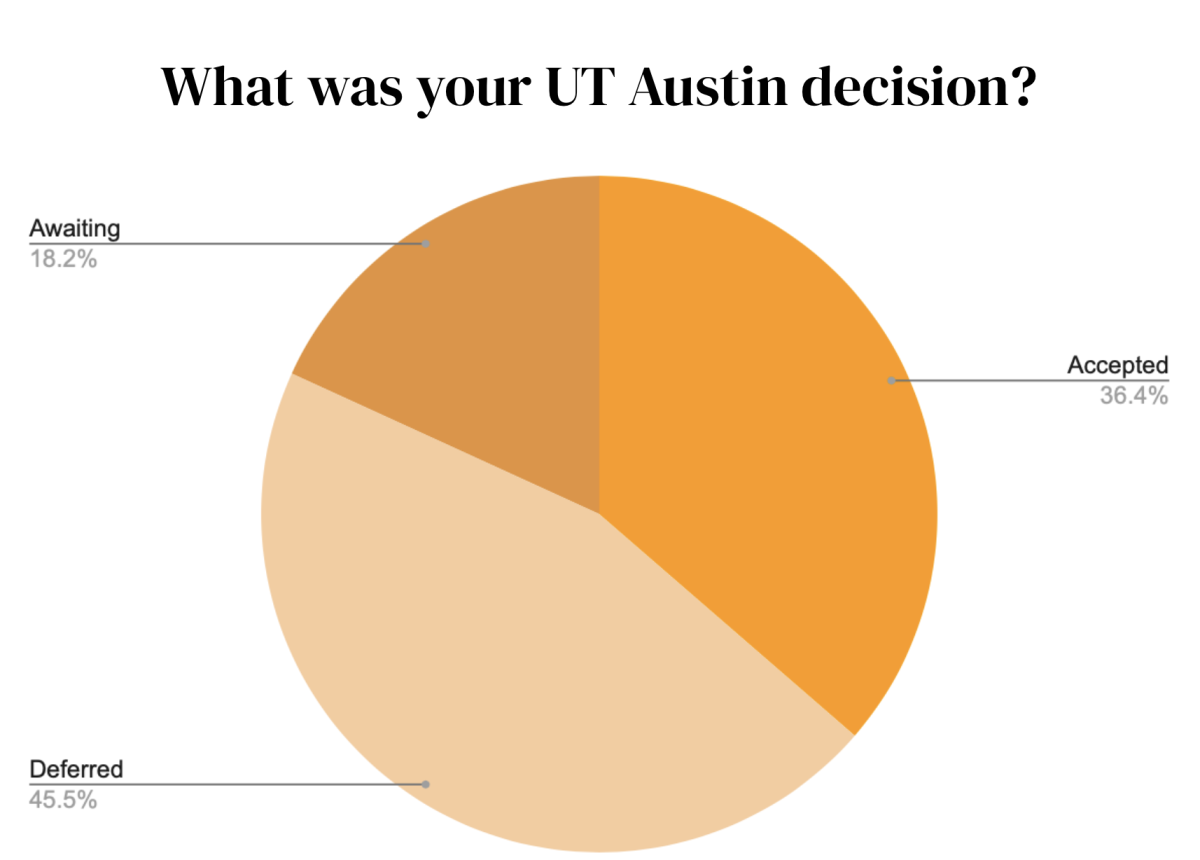
On Jan. 12, 198 Bellaire High School students and University of Texas applicants received the same mass email: “No denials will be issued at this time.”
For many Bellaire seniors, the anticipation of this round of UT Austin Early Action, a non- binding application that is reviewed earlier than regular decision, admissions decisions was high. Bellaire seniors consistently apply to the competitive institution, even those not auto-admit. Last year, 258 seniors applied to UT Austin.
“UT is the flagship university in Texas and has become one of the top universities in the country, which makes it extremely competitive,” college counselor Jasmine Thomas said. She encourages other students to know that “just because you didn’t get into UT, doesn’t mean you’re [not?] good enough — that’s not true. There are many other excellent universities with strong programs.”
With UT rising in national rankings and rising up to be one of the most-applied-to universities with almost 100,000 applicants, deferrals have increased, including for auto-admitted students.
“Students who apply Early Action put in extra time to prepare their applications earlier, writing essays, securing letters of recommendation and meeting earlier deadlines,” Thomas said. “There’s nothing wrong with applying Regular Decision, but the expectation is that if you apply earlier, you receive an earlier decision. Taking that away from Early Action applicants isn’t fair.”
With about 95% of applicants getting deferred, seniors have doubted the reliability and efficiency of UT’s admissions process. Senior Nicolette Berry, who was accepted to UT as an Environmental Science major, said deferrals can be disappointing for applicants who are hoping for a final decision.
“I think they should try to keep those decisions separate. Especially considering how overwhelmed they were last year, adding more students into the same pool of decisions and acceptances just makes things more complicated. It doesn’t really make sense, and I don’t think it’s fair,” Berry said. “I think it can get people’s hopes up because it prolongs the process instead of giving a more definitive answer.”
Berry also shared that many of the students she knows who were accepted to UT Austin applied to smaller, less competitive majors.
“From what I’ve seen, many of the students who did get in applied for majors like Environmental Science or Sustainability Studies,” Berry said. “That’s part of why I applied to that major; I felt I had a better chance compared to more competitive majors like Biology.”
Senior Brayden Nguyen, who got deferred from UT, said that while the situation is frustrating, deferrals may be UT’s only solution when faced with mass amounts of applications.
“If they can’t get to all the applications, what else can they really do?” Nguyen said. “Deferring is kind of their only option. Ideally, I’d want them to release decisions when they say they will instead of deferring to so many people.”
Nguyen added that UT’s popularity in Texas contributes to how personally students take deferrals and rejections.
“UT is a really big deal, especially in places like Houston, where it feels like the school everyone applies to,” Nguyen said. “But at the end of the day, [there are other schools].”
Some students have taken into account how the university’s admissions process has evolved.
“I think the system they have now is better than what they did last year, when decisions were coming out monthly,” Thomas said. “It feels like they’re still trying to figure out their admissions process, but overall, I do think it’s slightly unfair to most students.”
For the graduating class of 2025, UT received approximately 91,000 freshman applications for the Fall 2025 semester. Decisions were delayed for a month, leaving many students holding off on committing to other colleges in the meantime.
Students who were deferred are now expecting a final decision on Feb. 15.