

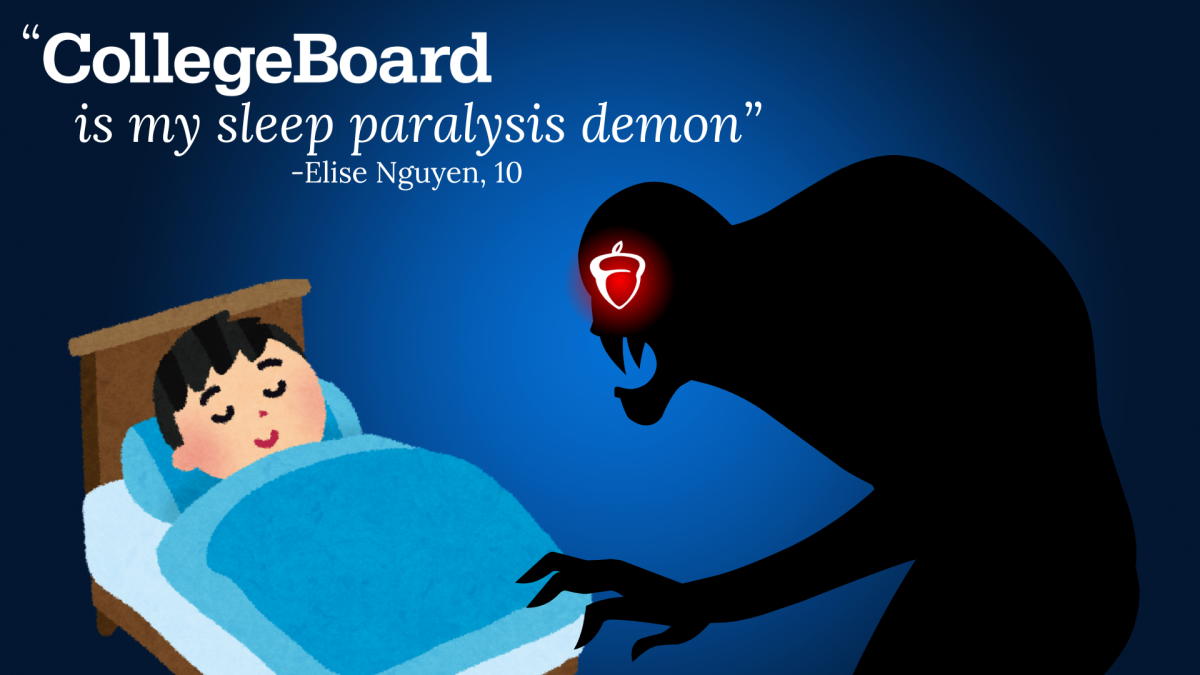
Approximately 88% of students at Bellaire who are enrolled in one or more AP classes average less than eight hours of sleep a day, according to a recent TPP survey with more than 200 student responses. The National Sleep Foundation (NSF) reports that sleeping less than nine hours a night is an hour and a half less than recommended.
As the number of students enrolling in AP courses continues to rise, so does the pressure to manage demanding coursework and limited time for rest according to junior Aayush Khadse. For Khadse, the heavy workload and pressure to excel come at the cost of a full night’s sleep.
“I feel really cranky on school mornings,” Khadse said. “Comparatively, on weekends when I get a full 10 hours of sleep, I feel much better. With the amount of work and the load of all my classes, it takes up my time for other things significantly.”
The NSF reported that from ages 14 to 16, the number of students sleeping more than eight hours a night drops from 23% to 19%. Junior Sarah Guillot said that students aren’t getting enough sleep because of rigorous course loads and academic pressure.
“I’m personally super tired from volunteering and doing college stuff that I want to go straight to bed but I still have to finish my AP and On-Ramps work,” Guillot said. “My On-Ramps teacher pushed back due dates for homework because he knows that some people are falling behind.”
While Guillot only takes one AP class, she said the academic culture itself contributes to stress.
“I think it’s more the idea of AP classes being hard,” Guillot said. “Other teachers are like, ‘Oh, you’re doing so much work in your AP classes, so I’m going to give you this workload too.’ It just piles up.”
Khadse, who is enrolled in a full schedule of AP courses, said the challenge comes not only from the content but also from the expectations surrounding it.
“Coming from an Asian household, there’s a lot of parental pressure,” Khadse said. “A lot of my friends are taking heavy course loads, so there’s peer pressure, too. Then, of course, there’s college pressure and GPA.”
Despite his effort to stay organized, Khadse said his days often blur into long stretches of studying and late nights.
“On a good day, I’ll spend about an hour and a half on homework,” Khadse said. “But on busy days, it’s four to five hours. I try to be asleep by 12:30 and wake up at 6:30.”
Khadse said the constant late nights leave little time for hobbies, rest or social life.
“I used to play games with my friends as a de-stressor,” Khadse said. “But I haven’t touched a game in over a year. It gets a lot harder to explore and enjoy other things when school takes such a big portion of your time.”
Senior and valedictorian Selina Chen said the impact of AP courses varies depending on the subject.
“For me, history classes usually have the most workload,” Chen said. “When I stay up late, it’s usually to study for a test.”
Chen said that while she’s managed her time well enough to balance academics and sleep, many of her peers are not as fortunate.
“I’ve seen people who have to choose between finishing homework and getting sleep,” Chen said. “It happens at least once or twice a week for some students.”
However, Columbia psychologist Dr. Blake Zakarin found that sleep deprivation can actually affect memory, focus and mood — skills essential for success in AP classes. But frequently, the pressure to keep up outweighs the need to rest.
“Despite the challenges, I would tell underclassmen to go for it,” Khadse said. “Push yourself, but know your limits. If a class doesn’t fit your schedule or interests, it’s okay to take a different route. It’s not worth losing your sleep or your sanity over it.”
History department head and AP World History teacher Justin Cothran said he regularly sees habits of poor sleep schedules as he often receives late-night messages from students.
“I get messages from students with very unhealthy timestamps, like 3 a.m.,” Cothran said. “My only advice is to budget and plan out your time weeks ahead.”
Cothran said Bellaire has a culture that leads students to endure the four-year course load despite a poor work-life balance.
“My main concern about my students in my AP classes is a lack of sleep, basic joy and [even] a lack of learning,” Cothran said.
Cothran said the poor work-life balance was partially due to the excessive number of AP classes taken by some students.
“AP courses are designed to be taken one or two per year and we have students in four or more,” Cothran said. “That’s the main issue.”
The CDC reports that nearly 72% of high schoolers sleep less than eight hours a night, which reflects a national trend and the commonality of student sleep deprivation.
“The ability to learn from mistakes, the willingness to make mistakes and the drive to push through is all that’s needed to succeed in AP classes.” Cothran said.









Kristine Szeto • Oct 27, 2025 at 7:49 am
Thank you for writing about this!
Macy Langland • Oct 26, 2025 at 6:26 pm
Great story that encapsulates what so many students struggle with. Well done!
Ellie Zacharia • Oct 26, 2025 at 4:53 pm
Such a real and important story! Great job!
Max Bui • Oct 23, 2025 at 11:19 pm
Such a relatable read! I loved the quotes as well, I thought they added so much more depth to the story! Awesome story overall!
Chloe Nguyen • Oct 23, 2025 at 10:58 am
This was such an amazing read!
Ishani • Oct 22, 2025 at 8:39 pm
I love this headline!!
Andrew Chen • Oct 22, 2025 at 1:57 pm
great story Marielle! u did a great job with how thorough the story is
Zoe Gamboa • Oct 21, 2025 at 8:36 pm
Super impressive! This is such an important story and you did great covering this! Awesome work Marielle <3