WARNING: Spoilers for “Wicked” and the first 30 minutes of “Wicked: For Good”
The concept *taps head* of “Wicked: For Good” being an amazing sequel.
Ha, in your dreams.
“Wicked: For Good,” directed by Jon M. Chu, “thrillified” (a term in the Ozian vocabulary) audiences in theaters, grossing $226 million internationally on its opening weekend.
I wasn’t exactly sure how to feel expectation-wise before the movie. On one hand, the insane marketing — Wicked MUNCHKINS at Dunkin’, Wicked Owala bottles, Wicked fragrances and even Wicked dish soap — generated an immense amount of buzz around the movie. Something this heavily promoted must be phenomenal, right? At the same time, however, my inner theater kid was holding space in the back of my mind, echoing that the second act is always worse than the first act.
Critics’ reviews of the film have been dramatically varying, with Justin Chang of The New Yorker calling it “very, very bad,” whereas The New York Time‘s Manohla Dargis praised the movie for its “coherence and strong heartbeat.”
But what do I think?
Well, it was “definishly” just alright.
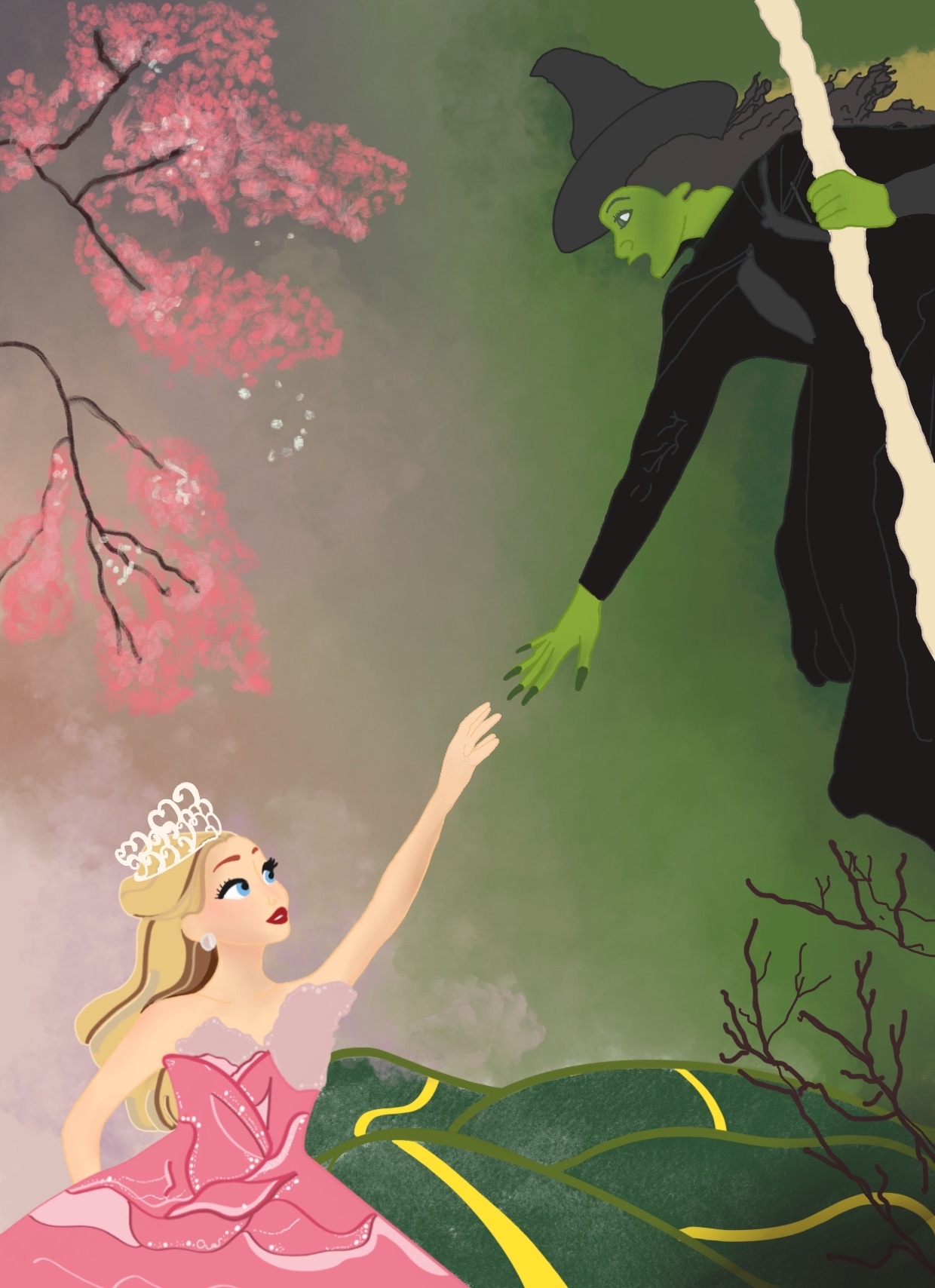
The film picks up right from where Wicked left off, depicting an awakened Elphaba (played by Cynthia Erivo), having recently “discoverated” that the Wizard of Oz (played by Jeff Goldblum) is a fraud, not truly capable of reading the Grimmerie. Now, Elphaba has become an almost Batman-esque figure, exacting a shadow of vengeance on the Wizard all over Oz. On the contrary, Glinda the Good (played by Ariana Grande) has found a way to finally make herself useful to the Wizard’s evil regime, creating a cult of personality centered around her and her determination to hunt down the Wicked Witch of the West — or as we know her, Elphaba. Overall, the movie is a message of the many tribulations involved with friendships that have been frayed due to external factors.
By far the most “horrendible” aspect of “Wicked: For Good” was its pacing. For comparison, Act 2 of the musical “Wicked” has a run time of approximately 60 minutes — “Wicked: For Good” comes in at a whopping 2 hours and 40 minutes. Furthermore, both Act 2 of the musical and the second movie have almost the same amount of songs in their tracklists, sharing songs such as “Thank Goodness,” “Wonderful” and, of course, “For Good.” Given that their soundtracks are so similar, there is absolutely no reason that the film adaptation should be practically three times as long as the stage production, with all of that extra time filled with senseless dialogue that did nothing to progress the plot. They were milking all that they could out of this story. And it shows.
In terms of acting performances, one crucial role ended up being a bit lackluster: Michelle Yeoh as Madame Morrible. Not to discredit any of her other phenomenal work that she has done, but she is just simply not fit for the role — the juxtaposition of her screaming something along the lines of “the witch is wicked, she’s trying to destroy Oz, kill her, blah blah blah” in such a sweet voice creates an almost comedic effect. To be fair, the writing isn’t doing her any favors, giving her possibly the most redundant dialogue ever, with every line having something to do with killing Elphaba. Perhaps we should say “Madame Morrible, MM, flip it around, Worst Writing!”
As mentioned earlier, the film dragged on, almost painfully, as the time was filled up with useless dialogue and pointless songs — specifically, the original songs (“No Place Like Home” and “The Girl in the Bubble”) written for the movie by the composer of the musical, Stephen Schwartz. “No Place Like Home” was just bad. It’s so immensely forgettable that one of the only things memorable about it is that it was one of Erivo’s songs. We all know that Elphaba loves Oz, her home — a 3 minute and 51 second, generic musical number isn’t needed to convey that. Similarly, “The Girl in the Bubble” is a desperate attempt to add a few minutes onto the film. However, Grande’s stellar performance somehow moderately saved this song — now, it still wasn’t necessary, as it didn’t add to the plot at all, but it was a great portrayal of Glinda’s emotions.
The most impactful piece of this film was most certainly the dynamic between Elphaba and Glinda. Erivo and Grande beautifully illustrate a relationship where, despite betrayal and resentment, they are always drawn back to each other. Even after their dramatic parting of ways in “Defying Gravity,” the bond that they possess is truly inseverable. Their inspiring friendship is certain to invoke audiences to examine their own personal relationships in their lives.
Moreover, approaching “Wicked: For Good” from a broader perspective, a piece of media is always created for a reason. The movie is an allegory for the polarization prevalent in current politics. The Wizard’s dissemination of propaganda and fabrication of a common enemy — The Wicked Witch of the West — mimics the actions of many world leaders today, who harm the lives of minorities in order to accomplish a political agenda. Furthermore, the regime’s attempt to silence Elphaba and to prevent her from speaking her truth reflects the tendency in today’s political landscape of eliminating dissenting voices. While it is true that these current political issues have been seen throughout history, the recent intensification of them by increasingly radical political ideologies was most certainly a factor considered when deciding to make this film and to tell this story specifically.
The allegory was effectively communicated through blatant yet easily-digestable symbolism. Even the first scene of the movie depicts the oppression of a targeted group — the animals of Oz, an image much simpler and less frightening for younger audiences to digest than the subjugation of humans.
Largely due to pacing issues, “Wicked: For Good” should have never been an independent movie. “Wicked” and “Wicked: For Good” could have simply been condensed into one, three-hour movie, throwing out all of the nonsense, staying with the plot and getting rid of the need for those forgettable original songs.
The movie had sincerely powerful allegorical and emotional messages, but they were unfortunately overshadowed by a blatant money grab, dividing a one-fold story into two despite its negative impact on the telling of the narrative.
While “Wicked: For Good” did not make me “rejoicify,” the film’s financial success undoubtedly delighted the producers at Universal Studios.