

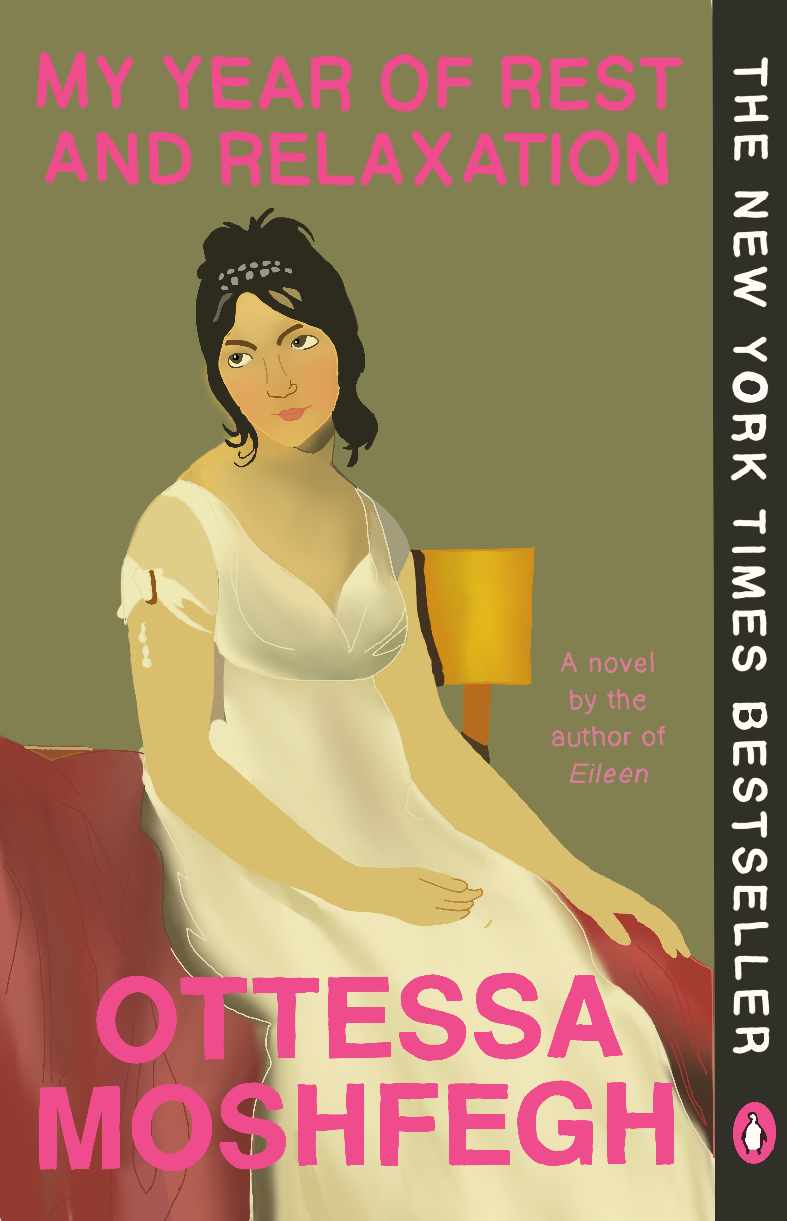
“My past life would be but a dream, and I could start over without regrets, bolstered by the bliss and serenity that I would have accumulated in my year of rest and relaxation.”
This idea of rebirth through rest drives the plot of “My Year of Rest and Relaxation” by Ottessa Moshfegh. “My Year of Rest and Relaxation” tells the story of a pretty, privileged, Columbia graduate who inherited a small fortune from her dead parents. Her father died of cancer and her mother committed suicide soon after. The unnamed protagonist, who lives in New York City in the year 2000, decides to try to sleep as much as possible for a year using a cocktail of prescription drugs acquired from a quack psychiatrist, Dr. Tuttle, in the hopes of waking up “reborn.”
While the idea of entering a yearlong drug-induced sleep is unique to say the least — overall, the premise of the book was an amalgamation of stereotypes. To begin with, the protagonist’s only friend, a young jewish woman named Reva, is described by the protagonist as a “a slave to vanity and status” who she only spends time with to feel better about herself. The entire book is populated with stock characters, from Ping Xi, a quasi radical artist, to the protagonist’s memories of her perpetually alcoholic and narcissistic mother – both common character archetypes in media. The consistent lack of complexity in the portrayal of the characters, aside from the protagonist, led me to wonder, ‘Is the main character’s position as an unreliable narrator and misanthropist what casts the characters as grotesque stereotypes?’ Or did the author simply not bother to add nuance to any of the side characters?
The book reads as a call for introspection, inviting the reader to consider what would happen if their laziness and depravity was taken to the extreme. But, the conditions under which a reader could experience this self reflection is limited. The internal conflicts the protagonist faces are only relevant to a small subset of people. The protagonist’s apathy, a key tenet of her journey, is enabled by her privilege. Numerous times throughout the book, she enumerates news headlines from newspapers in her local bodega, such as “The new president was going to be hard on terrorists. A Harlem teenager had thrown her newborn baby down a sewage drain. A mine caved in somewhere in South America,” and steadfastly ignores these issues. She also mentions never watching the movie, “The Color Purple,” despite the fact that it stars her favorite actress because it’s“ too sad.”
However, the ability to frame engagement with current events and injustice as just another form of performance and pretense is a mindset that can only be afforded to people free from tragedy and injustice. Ironically, this book ultimately caters to the very cultured elite whose superficiality the book aims and fails to critique. “My Year of Rest and Relaxation” became a part of the archetypal creation of social stratification through rejection of the conventional. Even for the small people who would read and empathize with the protagonist, the book still fails to actively challenge their world view and simply romanticizes their struggles.
However, in spite of these issues, Moshfegh delivered on writing style. The author captured the ennui and neurotic stream of consciousness of the protagonist with eloquence. While her characters lacked nuance, her writing did not. Moshfegh skillfully captured individual moments or feelings and littered the novel with masterful absurdity. Her technical ability as a writer was on full display throughout, and in spite of the book’s overarching flaws, at a basic level it’s pleasant to read because of Moshfegh’s writing capabilities. But ultimately, Moshfegh lacked the ability to use this technical writing prowess to discuss themes which hold actual relevance.
In retrospect, the protagonist’s hibernation could be seen as a partial coping mechanism for her grief over her parents who she never felt close with. Admittedly, grief is a motif throughout the book, but the theme is never addressed head on, it simply recurs quietly. The book comes to a close soon after that author “wakes up” in June 2001, supposedly “reborn.” This rebirth is not dramatic or distinctive – she simply begins to slowly live life like an ordinary person again, until the 9/11 bombing of the Twin Towers. Her best friend, Reva, dies in the attack. While watching video footage of the incident, the main character remarks on watching a high-heeled woman jumping from the towers, saying, “…she is beautiful. There she is, a human being, diving into the unknown, and she is wide awake.” This quote turns the notion of sleeping in the hopes of rebirth on its head. Instead, it seems as if the protagonist was not looking for a new life, but simply the desire to live, hinting that her hatred of everyone and everything was a facade to cover up self-loathing.
The protagonist was a terrible person who made terrible decisions, which rendered her utterly unlikable as a character; this was perhaps the most original aspect of this book. But, aside from the protagonist’s unusual personality, the book fell into conventional tropes and ideas. While the author’s writing style was undeniably impressive, “My Year of Rest and Relaxation” essentially missed the mark in every other regard.

















Ayana • Mar 4, 2026 at 8:30 pm
love this!