
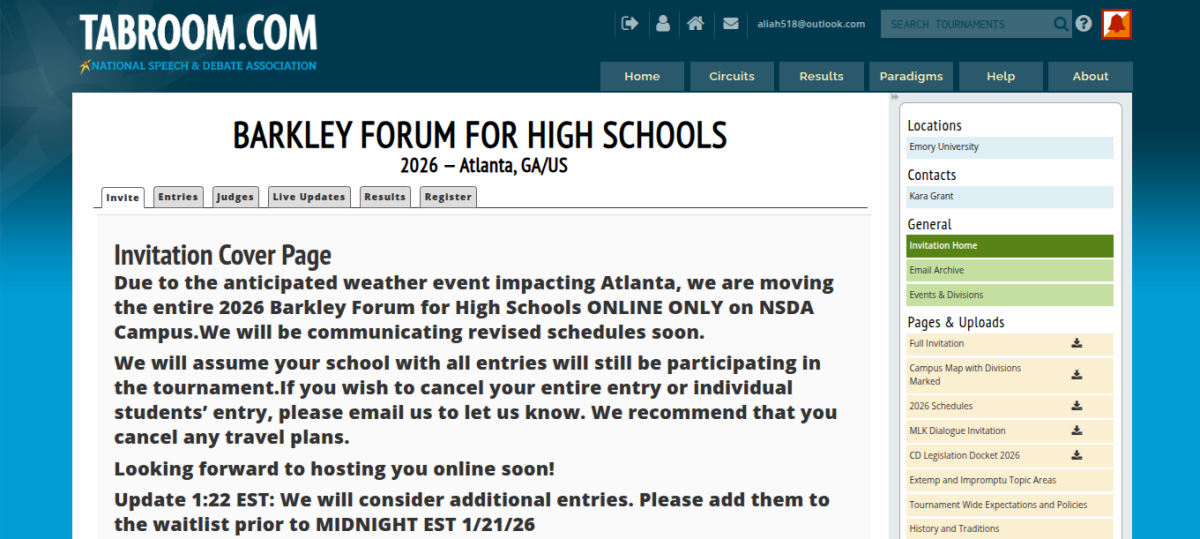
The 71st annual Barkley Forum tournament set to take place at Emory University was canceled and moved entirely online on Jan. 21. The debate team was forced to cancel all travel plans less than 24 hours before their departing flight.
The tournament was forced to shift online due to news of a powerful winter storm, with half to a full inch of ice projected to make travel difficult and dangerous for teams coming from across the nation.
“Any project where you are putting double digit groups of students on planes to travel is challenging,” Debate Coach and AP Research teacher Isaac Chao said. “But the most difficult choice I had to make was whether or not to cancel the trip altogether. It took more than one conversation with various debate coaches around the state to determine that, for safety reasons, it didn't make sense for us to go anymore. Given that the tournament itself moved online shortly after our decision and the university also shut down the day campus, in hindsight, I think we made a good call.”
Despite the last-minute change, the debate team acquired four bids to the 2026 Tournament of Champions (TOC) held at the University of Kentucky in April. Every competitor must attain two bids by placing highly at select competitive tournaments in order to qualify to the TOC, one of the world’s most prestigious speech and debate tournaments.
Seniors Samantha Tran and Alia Hassan as well as freshman Laila Hassan received a bid in Congressional debate, and juniors Ayub Ahmed and Leo Cheng received a bid in Public Forum (PF) debate.
For the senior debaters, knowing they wouldn’t get to experience an in-person travel tournament to Emory again was “heartbreaking.”
“It feels unfinished,” Tran said. “Emory has always been such a physical place for me, and ending it through a screen makes it harder to emotionally process that it’s really over. It means I’ve had to find closure internally instead of through rituals such as no final team dinner, no last walk around campus, no more pictures. That was really difficult for me to accept.”
For the team, the biggest loss was not being able to bond through travelling together.
“Everyone was super sad and disappointed,” Laila Hassan said. “Everyone gets drained from debate, whether it's online or in person, but I think that the fact that we would have all been there rooming together, talking after and in between rounds and just hanging out with each other would have kept the energy alive. I'm upset that that couldn’t happen.”
The six PF competitors decided to compete at junior Aashrith Korampally’s house to be together during the competition process.
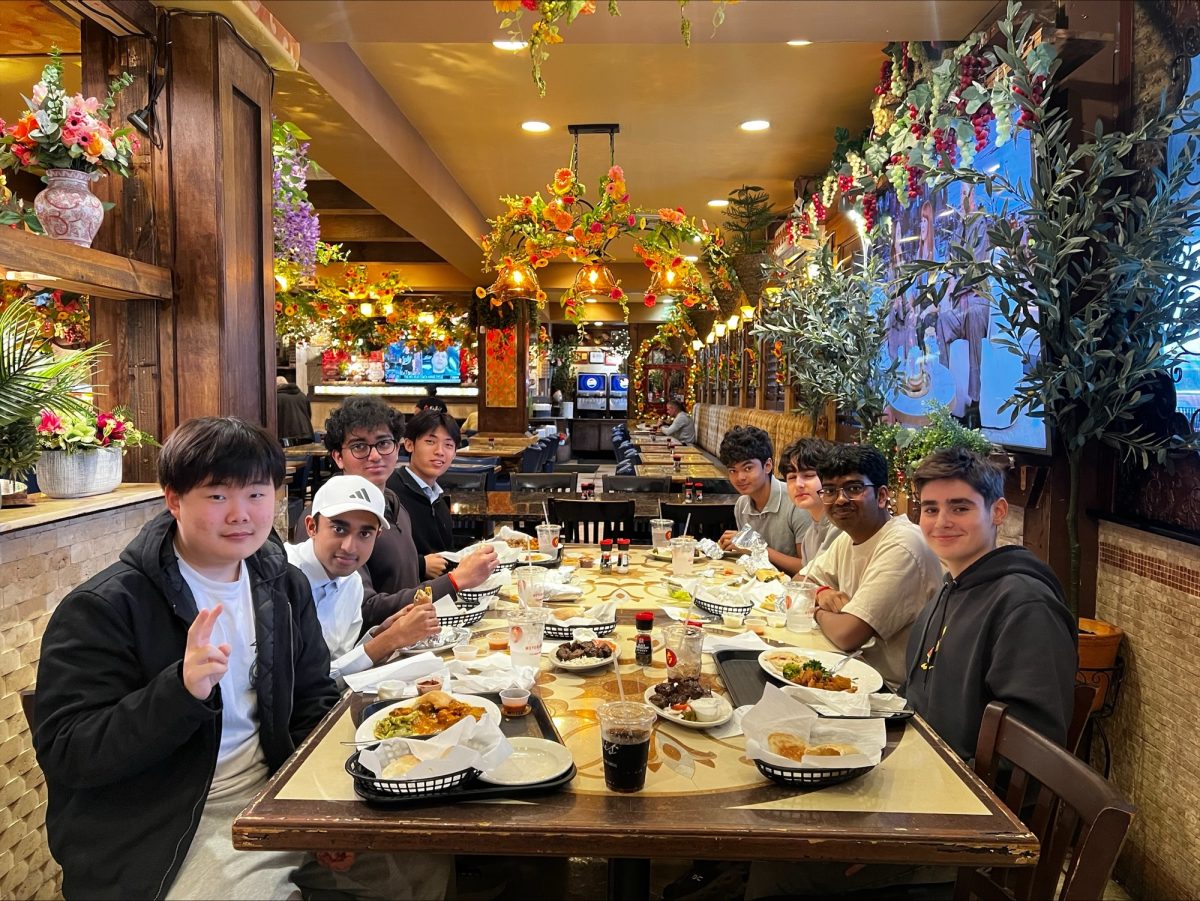
Although the online switch was “disappointing,” it marked a significant moment for Ahmed and Cheng, as they were the first PF team to acquire a bid this year. The team earned a gold bid, which qualifies them for the higher level of PF competition at the TOC, rather than a silver bid, which places teams in the lower division.
“We did an egregious amount of prep,” Cheng said. “We weren’t exactly surprised when we got the bid, but just more glad that the work had finally paid off. It’s super late into the season, so finally achieving that goal felt really good.”
This is the first tournament season that Ahmed and Cheng partnered up together, and they did 900 pages of prep for their topic about the People’s Republic of China reducing its international extraction of natural resources.
Beyond the research, they did over 10 practice rounds with the other two PF teams, junior team Aashrith Korampally and Aayush Khadse and freshman team Luka Rahman and Joseph Hurtado, attending the tournament. But their current practice stems from the norms set by the seniors from last year’s season.
“We couldn’t have done it without all the support we got from our former teammates that graduated, as well as our friends from the current circuit who helped us prepare,” Cheng said. “I’m really grateful to Feifan and Mingyi, our PF teammates from last year, for setting up a system for PF to do well even after they graduated.”
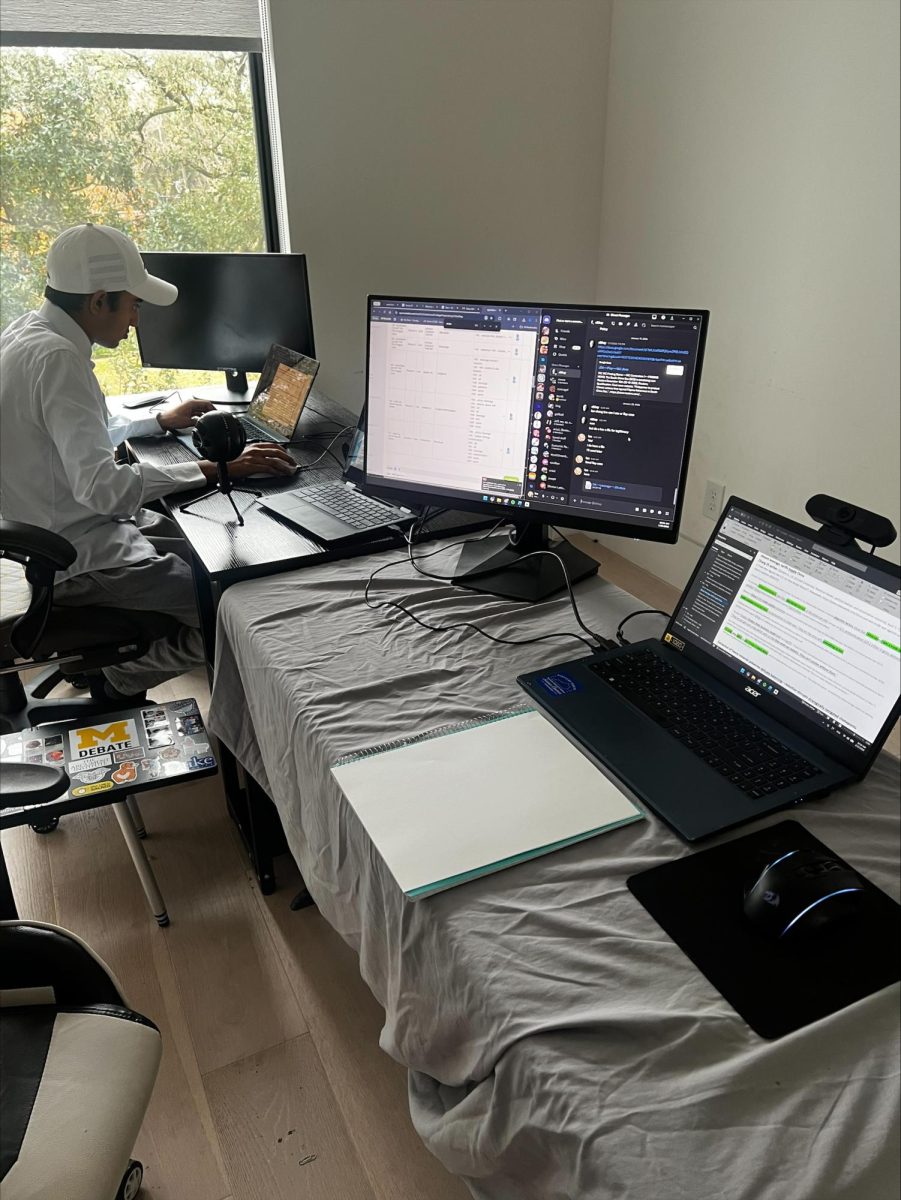
Although the debaters were able to somewhat adjust to the online format, for senior and Informative Speaking competitor Eliza Teo, competing in a speech event primarily about visual aids and presentation was “not the same.”
“Logistically it was really difficult,” Teo said. “I had to rely on our school Chromebooks and borrowed microphones, which wasn’t ideal. On top of that, making sure your body movements and boards stay in frame is really hard. Not being in that environment really changed my focus and commitment levels. It's so easy for one to just turn their volume off and not listen to other people's speeches, or just not project as much, be as funny, as confident, because ultimately you’re just talking to a screen.”
Teo and junior Ishani Kaushik came into the tournament with one of the two bids needed to qualify to the TOC in Informative Speaking. As they did not advance past prelims and therefore, did not bid, there is only one tournament left that they are able to qualify at: the Bellaire Forensic Tournament hosted on Feb. 6 and 7.
“I really wanted to get my second bid this tournament, because that’s what I did last year when I semi-finaled at Emory,” Teo said. “My rankings in prelims were unfortunately not that good, so I didn’t advance at all. Being at home and not surrounded by my teammates was depressing. I now feel a lot of pressure to bid at the Bellaire tournament, as that is my last chance to qualify.”
Beyond the technological difficulty, the team was worried that they would lose Wi-Fi to compete during the storm. Tran’s internet went out right before her quarterfinal round.
“No matter what I tried, my Wi-Fi wouldn’t stabilize, which meant I couldn’t prep for quarters,” Tran said. “My mom and I were debating whether we should stay at home and risk the possibility of my Wi-Fi not coming back on or to drive somewhere else. Fortunately, my Wi-Fi came back on in the end and I was able to compete, but I know that was not the case for other teams, who lost Wi-Fi in the middle of their rounds.”
Congressional debate’s unique challenge in prepping was the sheer number of topics they needed to prepare in a two-week time window. Compared to the other debate formats with a single topic, Congress had to prepare an affirmative and negative speech for 15 different topics.
“Prepping was by far the most difficult part, because my team and I were behind on prep due to a lack of organization and accountability,” Tran said. “When prep is behind, we are forced to stay up extremely late and prep last minute for speeches we are missing. That was frustrating for all of us.”
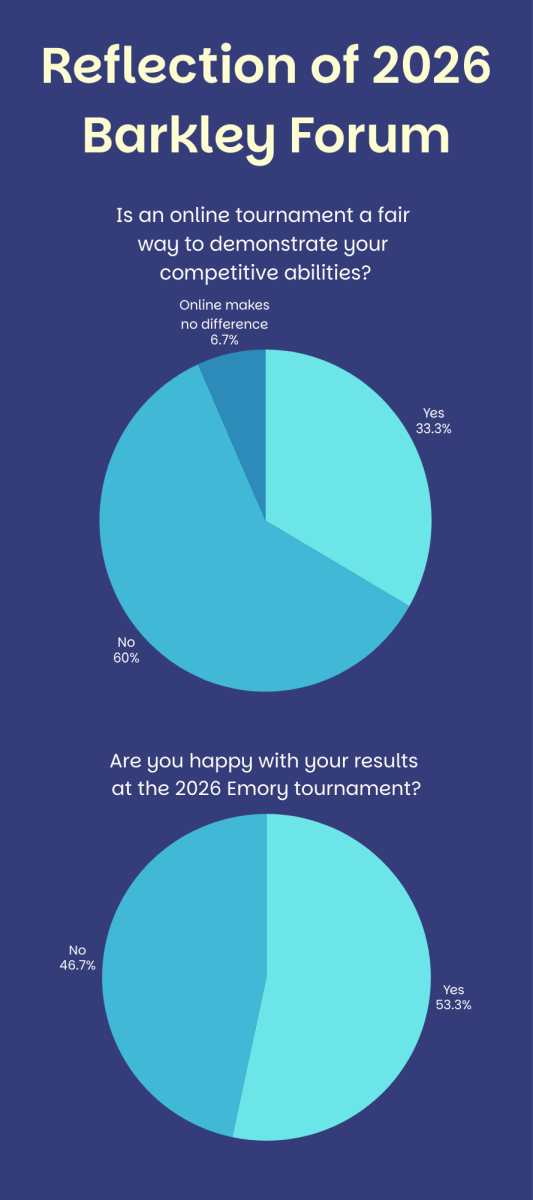
Although not having the ideal first experience she dreamed of, for Laila Hassan, Emory was still a valuable experience for her to apply to her remaining three years in Congressional Debate.
“This year, I got to see seniors really lead and delegate prep out to people and show us how the research and speech-writing process was done for these bigger tournaments,” Laila Hassan said. “For next year, I'm a lot better equipped to lead the prep process just because I saw how they helped us. Thanks to [the seniors], I had a lot more motivation to do really good prep knowing that next year they won’t be there.”
Knowing this is her last year, Teo tried to look at the bright side to Emory and reflect on the growth that has happened from an Informative journey that started two years ago.
“It’s bittersweet,” Teo said. “But that’s the beauty of speech and debate. It’s unpredictable, but ultimately, it shaped me a lot in high school. And I know in the future, I’ll find other outlets, environments, and people that will shape who I am later on.”
zara bukhari • Feb 1, 2026 at 1:32 pm
great story alia!
Ethan • Jan 31, 2026 at 9:45 pm
Such a good story Alia!