
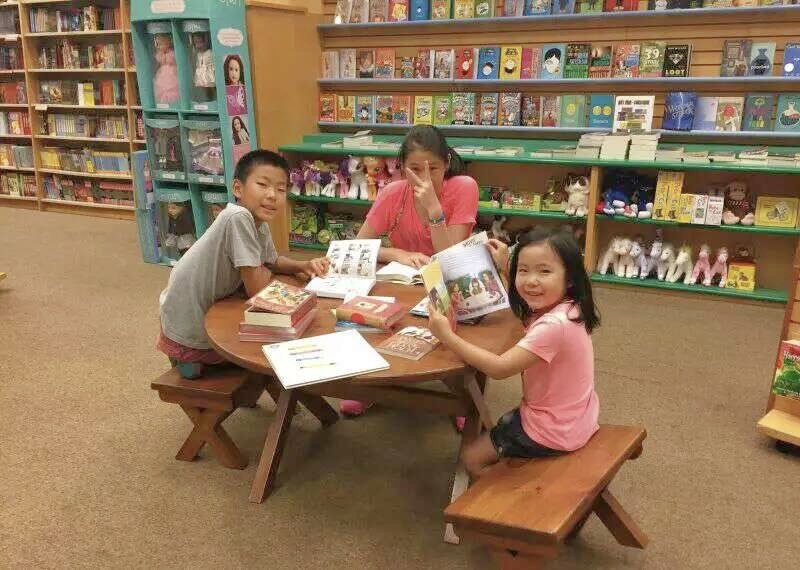
When I arrived in America at the age of 4, I knew two words — my first and last name. Yet in elementary school, I learned and loved hundreds more. I found sanctuary in Barnes & Noble, a 10-minute walk away from home. Titles from Judy Moody to Pinkalicious picture books took root. Instead of buying Dork Diaries, I read the entire series curled up behind the children’s storytime stage.
My family couldn’t afford extra tutoring or workbooks. Chinese was my primary household language. Still, those early trips to the library and accessible public reading spaces prepared me for a lifetime of learning. Now, as a high schooler hoping to major in English, I understand just how foundational they were.
But countless children do not have those same opportunities.
In our sprawling city of Houston, the Barbara Bush Houston Literacy Foundation found that just one book is available for every 300 children in low-income neighborhoods. Without spaces where reading feels natural, safe and accessible, literacy becomes intimidating instead of empowering. Families face not just time, financial and transportation barriers, but entire systems show no sympathy for the toxic stress from their poverty-driven 24/7 fight-or-flight mental state.
This problem has long-term repercussions beyond what people commonly believe — literacy is not just an academic benchmark. It is the basis for shared civic conversations. In 2022, research revealed 3% of state ballot propositions fell within the reading range of the average American adult. When the ballot itself is a literacy test, those who cannot fully comprehend it are less likely to show up.
Literacy falls off the political agenda because the very families who need these supports the most are the least equipped to advocate for them. The individuals who can actively choose inaction.
America’s political climate must acclimate itself to this simple reality. If communities are to meaningfully participate, if they are to step up at the ballot for the very lawmakers that champion voter turnout, they need strong foundations for early self-expression.
And that must begin with the youth.
I saw this disparity firsthand through Chapter Zero, a literacy initiative I launched with my peers — supported by Save the Children — to expand access to literacy opportunities for economically disadvantaged families. Through citywide book drives, we gathered thousands of donated books to assemble immersive literacy kits that encouraged shared reading routines. We reached early learners across Title I elementary schools, hospitals and shelters.
I have met parents who told me these were the first books their children had ever owned. I have watched young kids clutch the stuffed reading buddies to their books with shy excitement. I have seen the way their eyes light up upon rediscovering that reading is an exploration. But those moments were equally fulfilling and sobering because they revealed the scale of our nation’s literacy crisis.
My reach is only one out of 340 million American citizens. Even if every young person in the city rallied behind a momentous charge for early childhood literacy, the impact of our collective passion is limited to our communities. Charities and non-profits can spark change, but they cannot substitute the attention, investment and urgency of the people in power.
As it turns out, present structural investments only exist in theory. The Child Care and Development Block Grant is the federal government’s primary tool for helping low-income families afford child care and early learning. A CCDBG subsidy can slash a parent’s annual child care costs from over $13,000 to around $3,400. In practice, however, this funding only reaches 14% of the families who qualify. Yet for the third year in a row, Congress has proposed level funding for the program. After inflation, this is functionally a cut.
The New York Times Editorial Board puts it best: “Quality educational opportunities should not be luxury goods available only to those who can pay for them.” But this is exactly what early learning has become: a privilege.
Early childhood education must be at the forefront of the political agenda. Leaders must commit to accessible opportunities in increasing funding for early learning programs. Encouragingly, some are already taking initiative.
In Texas’ 7th Congressional District, our Representative Lizzie Fletcher launched Lizzie’s Little Learners in 2021, a district-wide reading challenge that encouraged elementary students to read at grade level through logging their progress. Little Learners who read more than 10 grade-level books were invited to a recognition ceremony with the Congresswoman.
At the national level, early learning spans party lines. In Sept. 2025, Senators Deb Fischer, a Republican from Nebraska, and Kirsten Gillibrand, a Democrat from New York, introduced the Child Care Modernization Act. This bipartisan bill proposes the reauthorization of CCDBG for the first time in over a decade, so more families can become eligible for increased, quality educational support for their children.
Accessible public spaces gave me the foundation to advocate for others. Through Chapter Zero, we are expanding a sustainable network of little libraries in parks and community spaces so that early learning can flourish for generations. Because when children are given the tools to understand the world, they grow into people who can change it.
Our nation’s children are waiting.













Angelina Tao • May 3, 2026 at 4:05 pm
i love this story. it’s great to see people advocating for such an important issue!
Zoe Gamboa • May 2, 2026 at 9:20 pm
This is so moving. Great job Elly!
Bethel Kifle • May 2, 2026 at 1:27 pm
Beautifully put. Such an important topic, well done!
Alav • May 2, 2026 at 10:39 am
Loved this! Very powerful Elly
Alia • May 1, 2026 at 10:48 pm
This is absolutely beautiful Elly! Incredible work