

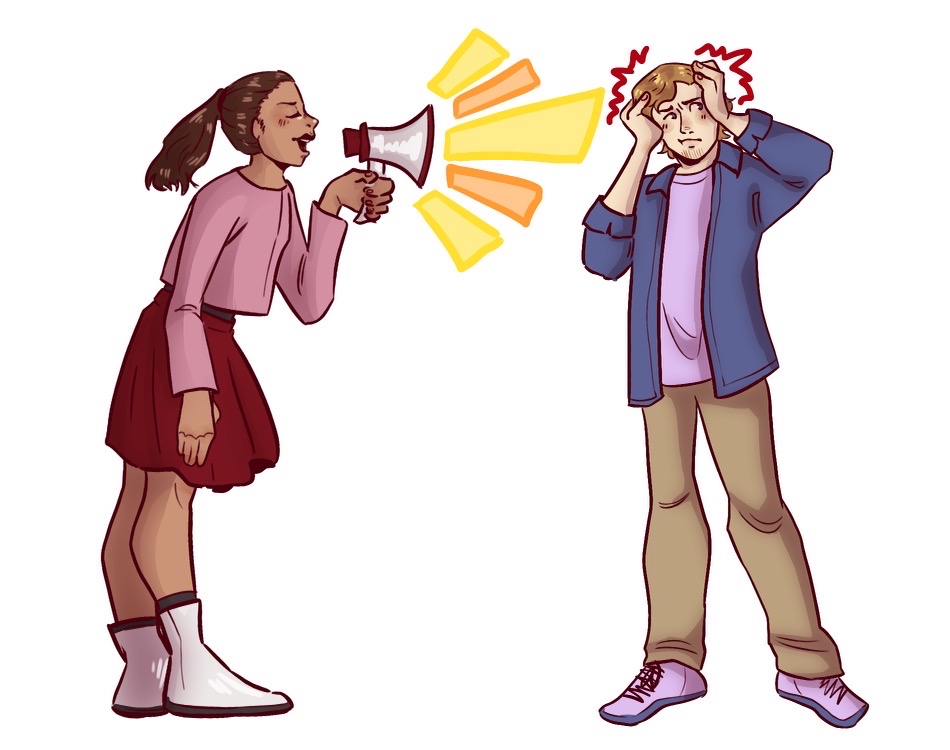
“Antes se queda el ruiseñor sin canción que la mujer sin conversación.”
Translation: “The nightingale would lose its song before a woman would lose her conversation” (Spain).
“Onna san-nin yoreba kashimashii.”
Translation: “When three women gather, it becomes noisy” (Japan).
“Ein Mann, ein Wort; eine Frau, ein Wörterbuch.”
Translation: “One man, one word; one woman, a dictionary” (Germany).
Even though Spain, Japan and Germany are separated by thousands of miles, their folk traditions produced similar proverbs with the same sentiment: women talk more than men.
I come from a long line of talkative women. In fact, it is a family joke that to get a word in at the dinner table, you have to raise your hand. But while my mother, aunt, and grandmother all jockey for their turn to talk, my grandpa is in the mix just as much as they are. I personally thought it was improbable that all women talk more than men because in my experience the amount someone talks depends on the person, not their gender.
According to sites like Today and Health Enews, women speak three times as much as men each day, with women saying 20,000 words compared to 7,000 from men. The reasoning behind these claims is that women have a higher level of a FOXP2 than men. While FOXP2, a protein that aids the development of speech and language, is higher in females, it does not determine how much a person speaks.
Every science teacher out there will tell you correlation does not equal causation. Just because on a biological level women might have a higher level of this language development protein, it does not mean on the whole that statistically women as a group speak more than men.
The idea that women talk more seems to come from anecdotal evidence instead of peer reviewed papers since no specific author or research is ever cited for the 20,000 to 7,000 word statistic. For all we know, these authors simply wanted to use this “data” to put women down. Widespread information that can be disproven from one simple Google search says more about the people, likely men, repeating it than the women they are talking about.
So, how did this falsehood get so widely spread? The findings that women speak more than men were first widely publicized in the 2006 New York Times bestseller “The Female Brain” by neuroscientist Louann Brizendine. The fact that this book was written by a woman highlights how patriarchal values have brainwashed women into dissuading them from contradicting male centric views by labeling their words as excessive and shallow.
Brizendien cited the 1985 self-help book “Talk Language: How to Use Conversation for Profit and Pleasure” by Alan Garner and Allan Pease for her statistics. However, Pease himself has presented different statistics claiming that women speak between 6,000 to 24,000 words per day. Furthermore, his books never cite specific studies to support these often inconsistent claims.
In 1998, Allan and Barbra Pease published a book called “Why Men Don’t Listen and Women Can’t Read Maps” which stated that women say 6,000 to 8,000 words per day while men say 2,000 to 4,000 words per day. In a later 2004 interview with CNN, Pease once again contradicted himself by stating that women speak 20,000 to 24,000 words per day compared to men’s 7,000 to 10,000 per day.
Pease eventually conceded his biased viewpoint and reverted to his original statistics 19 years later. Combined with research from the University of Arizona showing the lack of difference between the amount men and women speak, any old research stating otherwise was likely based on assumption or observations instead of data.
Wading through all of these flawed studies and statistics, I realized that part of the reason that accurate data is hard to obtain is because there are no studies that have been able to track the word counts of women and men over long periods of time.
Even when studies used an electronically-activated recorder (EAR) to log daily conversations of the user, they found that women had an average daily word count of 16,215 compared to men’s daily average word count of 15,669, a practically negligible difference.
In their findings, the most talkative person was a male with an average of 47,000 words a day, and the least talkative was also a male, averaging approximately 500 words a day. This shows that the amount that someone speaks is more dependent on the person’s personality than their gender, since both extremes were exhibited by men.
However, even this research had its limits because the device was only set to record for 30 seconds every 12 and a half minutes for up to 10 days. Additionally, these statistics were only from six samples. This limited recording time and test subjects cannot accurately count how many words someone will speak in one lifetime.
In “Understanding Gender Differences in Amount of Talk: A Critical Review of Research,” Deborah James and Janice Drakich analyzed the results of 56 separate studies:
This inconclusive data shows that the amount someone speaks cannot be broadly predicted by gender and highly varies on the circumstances of the person speaking. The amount of words someone speaks in their whole life is largely unquantifiable, which makes accurate statistical word counts of 20,000 or 7,000 words a day unattainable.
The myth that women speak significantly more than men says more about society than it does of women. When some statistics that have been repeatedly and scientifically disproved many times, you have to wonder why these falsehoods are still spread.
If we continue to accept false statistics as truth, we limit the participation of half the population based on unfounded beliefs. These statistics have been used in both professional and personal settings to undermine women who express their opinions. In many communities, perceptions of how much women talk are exaggerated based on expectations of how much women should talk, and these inaccuracies are then used to silence women who are seen as taking up “too much space.” So let us speak already. In any amount we want to.







Marielle Le • Apr 20, 2026 at 7:56 pm
i love this story! such a great take
Zoe Novak • Apr 16, 2026 at 1:38 pm
Amazing story! Love the lede!
Amanda • Feb 19, 2026 at 2:51 pm
Super interesting! Thanks for sharing!
Alav • Feb 18, 2026 at 8:45 am
been waiting for this, super interesting and great story!
Davis Adams • Feb 17, 2026 at 11:19 pm
so glad to see this get published, great work Sophia!