


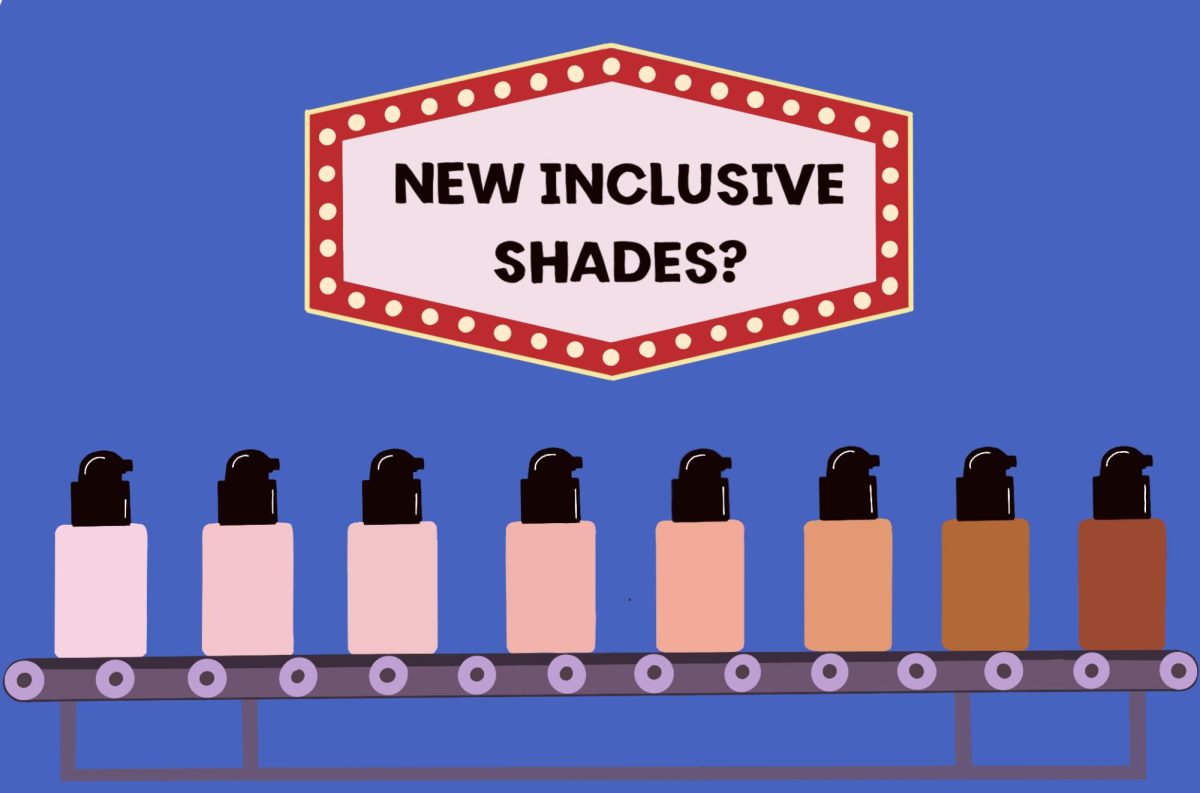
The world is full of color, yet the beauty industry is stuck in beige.
As someone with a warm, honey-toned complexion, I’ve learned that finding a concealer shade that actually matches me is more like a scavenger hunt than a shopping trip. My options are always the same: a few vaguely brown shades that lean too yellow, too gray or too light. So I end up settling for the closest thing, which never really looks right.
Makeup is supposed to celebrate self-expression, but for many people of color, it starts with frustration.
In a recent Three Penny Press poll, only 37% of students polled said they had “plenty of options.” Half said there were “some options, but not enough” and 13% said their options were “very limited.” Even more telling, 60% said they’ve struggled to find a makeup shade that matches their skin tone in another poll.
Walk down any drugstore makeup aisle and the imbalance is obvious. The lighter shades take up entire rows, each one slightly pinker or more golden than the next. But when it comes to deeper skin tones, you’ll find maybe three shades squeezed at the end, as if they were an obligation rather than an audience.
And if you’re dark-skinned?
Good luck.
The few brands that do carry a wider range usually come with luxury price tags, making true inclusivity something you have to pay extra for. Accessibility shouldn’t be a privilege.
When Barbadian singer and businesswoman Rihanna launched Fenty Beauty in 2017 with a groundbreaking 40-shade range, her brand became a catalyst toward inclusivity in the makeup industry. Fenty’s launch sold out worldwide and forced competitors to rethink what “standard” looks like. The myth that darker shades don’t sell disappeared overnight. Inclusivity was profitable and well overdue. No matter the retail price, it was clear that inclusive shades were now the bare minimum — and consumers wouldn’t settle for anything less.
To be fair, many drugstore brands have made progress since Fenty’s revolutionary inception. Maybelline, e.l.f and Essence now each advertise more than 30 foundation shades. That’s a huge step forward from where the industry was 10 years ago. But numbers alone don’t guarantee representation. If most of those shades cluster in the lighter range or if undertones for medium and deep complexions are missing, people are still left out. A warm honey-brown like mine can read yellow in one brand but gray in another. Undertones matter as much as depth.
So why is this still happening?
Part of the answer is cost and complexity. Formulating inclusive ranges means more pigments, testing and packaging runs. After the pandemic, supply-chain snags and inventory risks made some companies cautious about expanding further. While those are legitimate concerns, companies raking in millions of dollars in revenue should have the resources to make this possible, especially when we’ve already seen how successful inclusion can be. Even the brands that don’t have the capital of companies like Fenty shouldn’t be exempt from offering a basic, comprehensive range of shades.
Still, genuine inclusion is about more than simply adding darker colors to the lineup. It’s about nuance. When Youthforia tried to expand with its Date Night foundation in shade 600, consumers quickly noticed the formula was literally pitch black, with no undertone variation or real-world match. It was meant to check the inclusivity box, but it ended up illustrating exactly how not to do it.
While thoughtful inclusion is a dedicated process, the bottom line is that it’s possible. When K-Beauty brand TIRTIR came under fire in 2023 for the limited shade range of its Mask Fit Red Cushion foundation, they listened to their audience’s concerns and tried to mend their mistakes. The brand collaborated with influencer Golloria George to develop a shade range suitable to all consumers. Through trial and error, TIRTIR was able to expand their range to an outstanding 40 shades.
Makeup is supposed to help people feel confident, not excluded. True inclusivity is possible when it’s the starting point instead of the afterthought. It’s up to the rest of the beauty industry to turn that possibility into practice.
When someone like me can finally walk into a Target and find a product that truly matches my skintone, that’s when we’ll know beauty has become as inclusive as it claims to be. Until then, the lack of shade inclusivity will keep saying more than any marketing campaign ever could.











Mallika Mohan • Dec 14, 2025 at 10:32 pm
Amazing story Bethel!
Ayana • Dec 14, 2025 at 2:38 pm
YES BETHEL!!
Macy Langland • Dec 14, 2025 at 1:36 pm
Bethel you have started the BEST OF SNO TREND!!!
Bethel Kifle • Dec 14, 2025 at 3:54 pm
Ily Macy
Miti • Nov 22, 2025 at 4:20 pm
I love this so much! Awesome job, Bethel!
Ishani • Nov 20, 2025 at 12:05 pm
Your point about undertones is so true! I love this!
Rajan • Nov 19, 2025 at 2:33 pm
I love this story, great job bethel
Alia Hassan • Nov 19, 2025 at 1:29 pm
AMAZING job Bethel