



I’m standing in my driveway after taking a walk, a headphone in one of my ears as a black car pulls up beside me.
The mid-20s to early-30s year old driver rolls down their window and I can make out mumbled words through my music. I think it’s something urgent, so I fumble to turn down the volume on my phone and what he says will follow me forever.
“I have been watching you walk, and you should be a model.”
I stand there in disbelief while this adult goes on a five-minute rant, telling me that if I lose weight and learn through a few agency rejections, I can be signed.
When I smile and laugh uneasily, he tells me to start taking this seriously. He asks me my age, and when I tell him I’m a minor, he exclaims that that is the perfect age to start. As the minutes lapse, I get more uneasy, desperately waiting for him to leave me alone.
I wish I could say this was an isolated incident, but according to the National Sexual Violence Resource Center, 81% of women and 43% of men in the United States have experienced harrassment in their lifetimes, including students at Bellaire.
“I suppose it started around 6th grade,” said junior Audrey Lawrence. “One time, I was walking down to the Post in downtown Houston, taking pictures for my friend’s birthday when a bunch of teenage boys started yelling at us from their car and honking.”
Lawrence felt uncomfortable in the situation, and even though she couldn’t understand exactly what they were saying, she found their comments unwarranted and unwanted.
“It was just weird,” Lawrence said. “I know it happens to people all the time, so I try not to think much of it. But when I think of it, I get annoyed because I know the meaning behind it.”
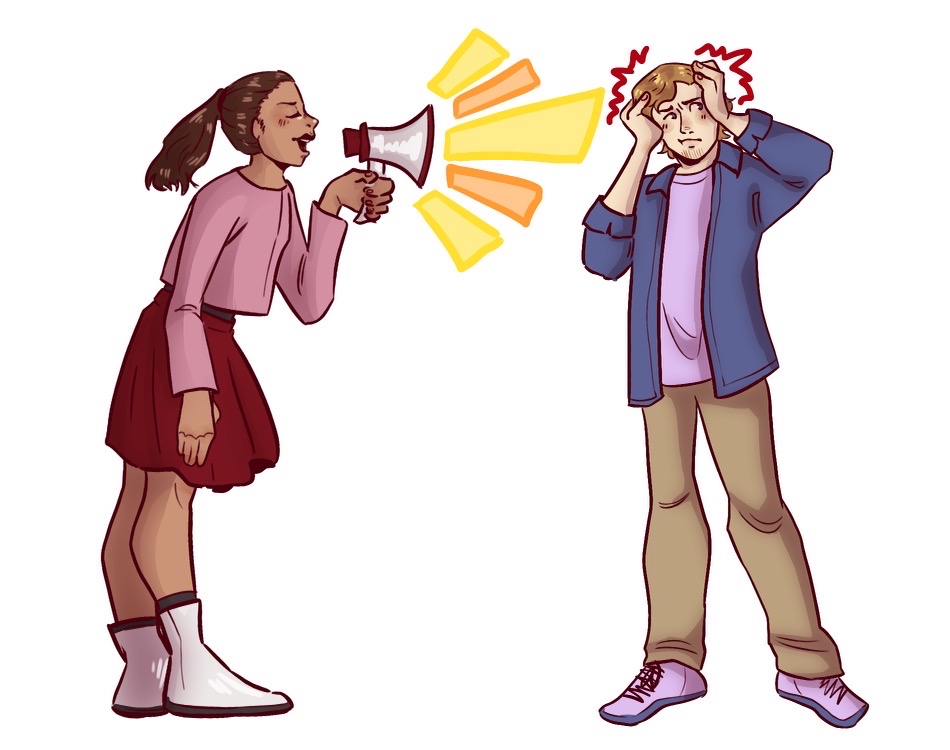
Harassment can be broadly described as unwelcome or threatening behavior, but many women experience a much more specific category of harassment—catcalling. Catcalling is a public comment or action of sexual nature, and, according to a study conducted by YouGov, 72% of the American public state that it is never appropriate to catcall someone.
“It’s a horrible feeling,” Pre-AP Biology teacher Dr. Christina Pichot said. “Even in a crowded place where your rational brain knows you should be physically safe, being catcalled triggers a very visceral, panicked feeling. You feel extremely vulnerable. Catcalling creates a power imbalance, even if it’s just perceived, that triggers that fight-or-flight instinct.”
Even though Pichot has been catcalled less after having children, she still carries many traumatic stories from her teens and 20s.
“I was followed and catcalled by a middle-aged man in a pick-up truck,” Pichot said. “It was terrifying! I tried to ignore him like I had been taught, but it didn’t discourage him. Luckily, he didn’t care enough to leave his truck, but the experience had a big impression on me.”
It has been found that 31% to 64% of men have admitted to catcalling a woman themselves. 85% catcalled to show their attraction to a woman, 83% to show sexual interest and 73% said it was a normal way of flirting. Catcalling, however, is not an appropriate way to start a relationship with anyone. It dehumanizes women and objectifies them to simply what they look like. Pichot is angered by people who choose to harass women.
“It also makes me very upset to think that some of my students could be engaged in the aggressor side of catcalling,” Pichot said. “I hope that they understand just how demeaning it feels for their target, and that catcalling is a form of harassment.”
Parent Kenya Ellis had an opportunity to see the other side of catcalling when her youngest son engaged in the behavior himself.
“It caused a problem because the girl’s older brother came up to him,” Ellis said. “And then we had a conversation, and I told him [the catcaller] that her [the girl’s] brother had a right to come up to him and defend his sister, so you have to be respectful of others, and especially girls.”
Catcalling is a Class B Misdemeanor under the Texas Penal Code Section 42.07 because a person who catcalls intends to harass, annoy, alarm, abuse, torment or embarrass another. It not only demeans people, but also restricts what they feel like they can do because of their fear of being attacked again, and that is unacceptable.
“If you’re giving someone a compliment, that’s one thing,” Ellis said, “But with catcalling, you’re calling someone out in front of other people and embarrassing them, and I don’t agree with that.”
In this society, women are told that it is their fault that they have to deal with unwanted attention. They are told that the reason they are preyed upon is because of the clothes they choose to wear or the things they do and don’t say.
However, I believe that the problem is not with the victim, but the aggressor, who utterly lacks respect for the people they persecute and who yearns to have their ego boosted by an uncomfortable smile from their target.















Mallika Mohan • Dec 14, 2025 at 10:31 pm
This is such an important topic, thanks for covering it!
Zoe N • Dec 14, 2025 at 5:47 pm
This is so incredibly vital to discuss. Such an amazing article, and so proud of you for winning a Best of Sno!
Jessica • Dec 14, 2025 at 12:49 pm
This is such an important and often forgotten issue. Thank you for covering this so well!
Christine Connolly • Nov 24, 2025 at 7:07 am
Great article addressing something that virtually all of us girls/women experience!
Lori Wilson-Reynolds • Nov 23, 2025 at 10:23 pm
Thank you for putting into words what everyone needs to know.
Alia Hassan • Nov 21, 2025 at 9:04 pm
Such an important issue to talk about. Amazing job!