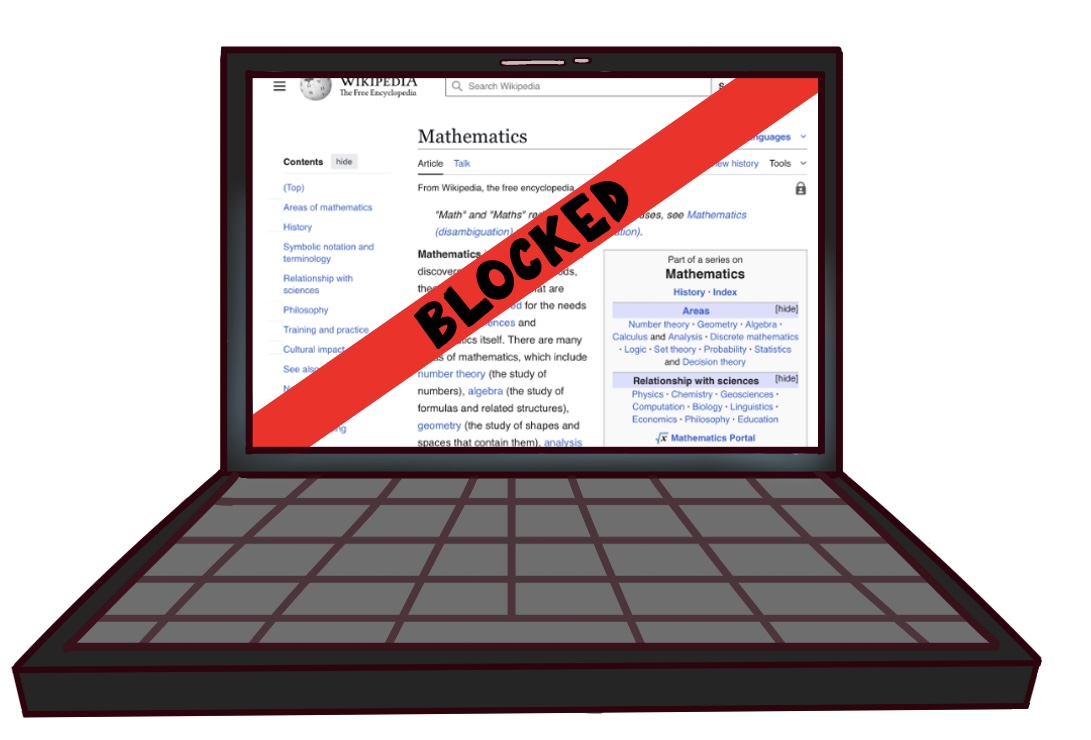
“Access to the requested site has been restricted due to its contents. If you feel the web page you are attempting to access is incorrectly blocked, you can ask for further assistance from the Service Desk.”
Everyone at Bellaire has seen this message at some point.
HISD’s internet restrictions are determined by district policy and the federal Children’s Internet Protection Act (CIPA), which requires schools to block access to content deemed harmful to minors. But the way filters are implemented across the district isn’t widely understood, with no explanation other than a vague paragraph on the blocked page.
HISD has implemented a system to manage the resources and websites available to students, utilizing a blacklist of known websites deemed “harmful” and keywords associated with such websites.
In its perfect form, the system would be useful, preventing access to malicious websites and guarding students from harm, consistently recognizing and preemptively stopping attempts to access resources that would distract or discourage learning.
Reality tells a different story: the system is anything but consistent.
While some harmful websites are blocked, several others that may be useful to students are blocked. Even TPP was affected since Otter.ai, the primary tool we use for transcribing interviews, was blocked earlier in the year due to a classification error.
While HISD aims to have student’s best interests in mind, blocking sites with broad keywords means beneficial resources are unavailable to students, while websites that enable students to cheat are easily accessible.
One of the core issues with HISD’s filtering system is how little agency students have within it. When a website is blocked, students cannot submit an appeal themselves. Only teachers can request a site be reviewed by submitting a ticket to HISD’s virtual IT agent, AskIt. This process can take up to a week with no guarantee of approval.
Teachers are already consumed by their busy workloads and lesson plans, leaving them little time to submit appeals for any and every blocked website a student might need. Furthermore, iIf an online resource doesn’t directly support a teacher’s curriculum, it’s unlikely to be prioritized for review.
As a result, students are left without access to tools that could help them academically succeed. In a school system that increasingly relies on digital learning, blocking these resources defeats the purpose of providing students with district-issued devices in the first place.
This system needs an overhaul.
Rather than preserving the status quo, with systems in place only for teachers to appeal bans directly hindering the progression of their course material, an avenue must be created for students, albeit with some modifications.
With over a billion websites existing on the web, manual review is impossible. However, an intersection between necessity and want exists.
To remedy the unilateral ban, an appeal system should be created for students, giving them an opportunity to appeal a specific URL with an attached reason, similar to the system available to instructors. However, with the number of students in any given district, the appeals should be grouped by URL, combining several requests into one and sorting the websites by the number of appeals.
If executed properly, HISD could significantly decrease the number of websites the administration has to review and give students a path to unbanning needed websites. This system relies upon the proposition that students within any given course would mass-appeal a central website vital to the curriculum, reflecting the number of appeals recorded.
While there certainly would be websites requested by students simply to see what they can get away with, the sorting system limits the mass movements while minimizing the number of links appealed and streamlining the review process to appeal rejections.
Even if HISD’s current way of blocking websites has been inefficient, the chance to reform the system is not completely lost. As our education becomes increasingly digitized, we need to be smart and responsible with how we use our technology, and enabling a system where a blocked website isn’t lost forever does just that.